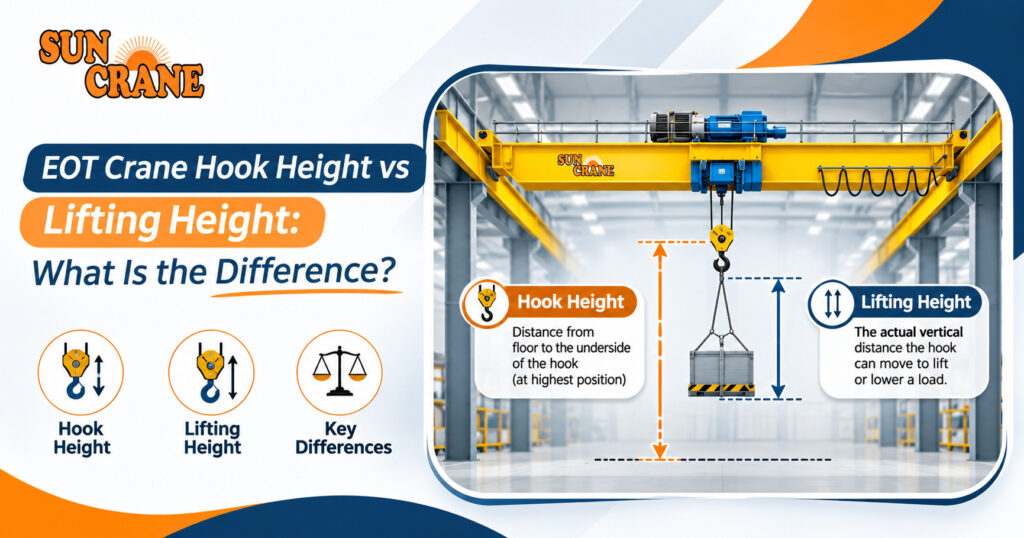
Hook height is a position. Lifting height is a distance travelled.
Hook height is the vertical distance from the floor to the hook’s load-bearing seat when the hook is at its highest position. Lifting height, often called “height of lift”, is the total vertical distance the hook can travel between its lowest and highest positions.
If the hook can drop all the way to the floor, the two numbers are the same. They come apart when the hook stops above the floor or goes below it, into a pit or a lower bay. That gap is where specification mistakes happen: a buyer asks for “8 metres”, the supplier hears “8 metres of lift”, and the crane arrives with the wrong rope or drum.
This guide explains both terms, shows how to measure them, and links them to span, hook approach and headroom.
What Is Hook Height on an EOT Crane?
Hook height (sometimes “height under hook”) is measured from the finished floor level to the saddle of the hook, the curved seat where the sling sits. It is measured with the hook raised to its upper limit. That upper position is set by the hoist’s upper limit switch, not by how far the rope could physically wind.
Three things decide how much hook height you need:
- The tallest obstacle the load must clear. This could be a machine, a stack of material or a vehicle in the bay.
- The height of the load itself when it’s slung.
- The rigging height. That’s slings, shackles, a spreader beam or a lifting magnet hanging between the hook and the load.
Hook height is a building-driven number. Once the crane is installed, raising it means moving the rails or changing the hoist, so fix it before the building’s column height is frozen.
What Is Lifting Height on an EOT Crane?
Lifting height is the vertical travel of the hook, from its lowest working position to its highest. In Indian specifications and in IS 3177 it is usually called the “height of lift”. CMAA specifications simply call it “lift”.
It’s a hoist-driven number. Lifting height decides:
- how much wire rope (or chain) the hoist carries
- the drum length and number of grooves
- the setting of the lower limit switch
- in practice, the hoist model a supplier can offer
When the hook only needs to reach the floor, lifting height equals hook height. When it needs to go below floor level, into a pit, a well or a lower loading dock, lifting height is greater than hook height. When it never needs to come lower than a work platform, lifting height can be less than hook height.
Hook Height vs Lifting Height: Comparison Table
| Point | Hook height | Lifting height (height of lift) |
|---|---|---|
| Definition | Floor level to hook saddle, hook at its highest position | Total vertical hook travel, lowest to highest position |
| Type of value | A fixed position | A travel distance |
| How it’s measured | From finished floor level (FFL) up to the hook seat at the upper limit | Hook seat at the upper limit minus hook seat at the lower limit |
| Reference point | Always the floor | The hook’s own two limit positions |
| What drives it | Tallest obstacle, load height, rigging height | Where the load must be picked up and set down |
| What it decides in the design | Rail level, column height, building headroom | Rope length, drum length, hoist selection, limit-switch settings |
| Why it matters | Too low and loads can’t clear machines | Too short and the hook can’t reach the pit or floor |
| Can it change after installation? | Rarely, as it needs rail or hoist changes | Sometimes, with a longer rope or drum if the hoist allows |
| When they’re equal | When the hook travels down to floor level | When the hook travels down to floor level |
How to Measure Hook Height and Lifting Height on Site
A laser distance meter and the building drawing are enough for a first estimate. The manufacturer confirms final figures on its general arrangement (GA) drawing.
Hook height formula
Required hook height = tallest obstacle + safety clearance + load height + rigging height
Measure the tallest fixed object the load must pass over. Add a clearance margin; many plants work with 300–500 mm, but follow your site’s own safety rules. Then add the height of the largest load and the full height of its slings and lifting gear when tensioned.
Lifting height formula
Lifting height = hook height − lowest hook position above floor
If the hook must go below floor level, the lowest position is negative, so:
Lifting height = hook height + pit (or below-floor) depth
If the hook only needs to reach floor level, lifting height = hook height.
On an existing crane, raise the unloaded hook to the upper limit and measure floor to saddle (hook height). Lower it to the lower limit, measure again and subtract (lifting height). Cordon off the area first.
EOT Crane Dimensions That Link the Two
Hook height and lifting height don’t sit on their own. On a GA drawing they’re tied to a chain of other EOT crane dimensions:
- Rail level (gantry rail top): the height of the rail the end carriages run on. It equals the hook height plus the hook-to-rail dimension.
- Hook-to-rail dimension: the distance from the hook saddle (at its highest point) to the rail top. It depends on the hoist, girder type and hook block, so take it from the manufacturer’s drawing.
- Crane height above rail: how far the crane’s highest point (crab, girder or walkway) rises above the rail.
- Headroom (clearance to roof): the gap between the top of the crane and the lowest roof member, such as the truss underside, purlin or lighting.
A useful check is:
Headroom = truss underside − (rail level + crane height above rail)
If headroom is negative, the crane won’t fit without a lower-headroom hoist, a double girder layout or a taller building. For a refresher on the parts involved, see Parts of an Overhead Crane.
EOT Crane Span: Where It Fits In
Height tells you how high the hook goes; span tells you how wide the crane is. Here is the short version. Our full guide on how to calculate EOT crane span covers it in more depth.
EOT crane span measurement
EOT crane span is the centre-to-centre distance between the two gantry rails. It is not the building width and not the column-to-column distance. Rails usually sit inboard of the column centres on brackets or a gantry girder, so span is always a little smaller than the column spacing.
Measure at several points along the bay. Columns are rarely perfectly parallel, and that variation, not the nominal figure, decides whether the wheels run smoothly.
EOT crane span calculation formula
Span (S) = column centre distance (C) − (rail offset on side 1 + rail offset on side 2)
Or, when working from clear width:
Span (S) = clear width between columns − (rail clearance on side 1 + rail clearance on side 2)
The offsets come from your structural drawing or the gantry girder design.
Worked example: overhead crane span calculation
Illustrative figures for explanation only. Your real values must come from site measurement and the manufacturer’s drawing.
A workshop has these dimensions:
- Column centre distance (C) = 16.0 m
- Rail offset from column centre = 0.5 m on each side
- Tallest machine in the bay = 3.2 m
- Safety clearance = 0.5 m
- Largest load height = 1.5 m
- Rigging height = 1.3 m
- Maintenance pit depth = 0.8 m
- Hook-to-rail dimension (from manufacturer) = 1.1 m
- Crane height above rail = 1.6 m
- Truss underside = 9.8 m above floor
Step 1 – Span: S = 16.0 − (0.5 + 0.5) = 15.0 m
Step 2 – Hook height: 3.2 + 0.5 + 1.5 + 1.3 = 6.5 m
Step 3 – Lifting height: 6.5 + 0.8 (pit) = 7.3 m
Step 4 – Rail level: 6.5 + 1.1 = 7.6 m
Step 5 – Headroom: 9.8 − (7.6 + 1.6) = 0.6 m
Here the hook height is 6.5 m but the lifting height is 7.3 m, because the hook has to go into the pit. If the enquiry had said only “6.5 m height”, the hoist might have been supplied with 0.8 m too little rope travel.
EOT Crane Design Calculation: Heights and Span Together
A practical EOT crane design calculation, from the buyer’s side, follows this order:
- Fix the load. Set the maximum safe working load (SWL), the largest load dimensions and the type of lifting gear.
- Fix the hook height using the obstacle, load and rigging formula.
- Fix the lifting height, adding any pit or below-floor depth.
- Measure the span at several points along the runway.
- Check rail level and headroom against the building, using the manufacturer’s hook-to-rail and crane-height figures.
- Confirm hook approach so you know the area the hook can actually cover.
The structural design (girder section, deflection, wheel loads, duty class, motor sizing) is the manufacturer’s job, following the relevant standards. Your job is accurate inputs: capacity, span, hook height, lifting height, duty, speeds and site constraints.
EOT Crane Hook Approach Length
Hook approach is how close the hook can get to the edge of the crane’s runway. It’s a key EOT crane dimension that buyers often leave out.
- Side hook approach (or lateral approach) is the minimum distance from a rail centre to the hook centre when the crab is at the end of its travel along the girder. There are two values, one for each side, and they’re often unequal, because the hoist motor and gearbox sit on one side.
- End hook approach is the minimum distance from the end wall or end stop to the hook centre when the crane is at the end of the runway.
Hook approach length varies with hoist type, crab design and capacity, so there’s no single standard figure; take it from the manufacturer’s GA drawing. It usually grows with capacity.
Hook approach sets your usable coverage:
Hook coverage width = span − (side approach 1 + side approach 2)
In the worked example above, with side approaches of 0.8 m and 1.0 m (illustrative), the hook covers 15.0 − 1.8 = 13.2 m of the 15.0 m span. Machines in the outer strips can’t be served by a vertical lift, and side-pulling to reach them is unsafe. A double girder EOT crane with a top-running crab can sometimes offer better approach and headroom than a single girder design. The right answer depends on capacity and span.
Standards to Reference: IS 3177, IS 807 and CMAA
- IS 3177 – Code of Practice for Electric Overhead Travelling Cranes and Gantry Cranes Other Than Steel Works Cranes. This is the main Indian standard for general-purpose EOT cranes. It covers classification, design and the information a purchaser should supply, including height of lift.
- IS 807 – Design, Erection and Testing (Structural Portion) of Cranes and Hoists. This covers the structural design of girders and end carriages, including load combinations and deflection.
- CMAA Specification 70 (multiple girder) and 74 (single girder) from the Crane Manufacturers Association of America. These are widely used international references, and they define “lift” as the maximum vertical hook travel.
Ask your supplier to state the standard and edition on the quotation. In India, lifting machines in factories must also be thoroughly examined by a competent person at least once every 12 months under the Factories Act, 1948, and state factory rules can add further requirements.
Common Mistakes When Specifying Heights
- Giving one “height” figure without saying whether it’s hook height or lifting height.
- Measuring to the hook tip instead of the saddle. The tip sits above the seat, so it overstates hook height.
- Forgetting the rigging. A spreader beam can take up a metre or more of hook height.
- Ignoring pits and below-floor lifts, which add to lifting height but not hook height.
- Using building width as span instead of rail centres.
- Freezing the building first and finding later that headroom is negative.
Get Your Crane Dimensions Checked by Sun Crane
Sun Crane designs and manufactures EOT and overhead cranes from its works at GIDC, Vapi, Gujarat. Share your column layout, roof height, load details and pit depths, and the team can review hook height, lifting height, span and hook approach before a final drawing is issued.
Browse the EOT crane range or contact Sun Crane to discuss your layout.
Frequently Asked Questions
Hook height is the distance from the floor to the hook saddle when the hook is fully raised. Lifting height is the total distance the hook can travel up and down. They’re equal only when the hook can lower all the way to floor level.
Yes. “Height of lift” is the term used in IS 3177 and in many Indian quotations, and CMAA calls it “lift”. All three mean the maximum vertical hook travel between the lowest and highest positions.
Add the height of the tallest obstacle, a safety clearance, the height of the load and the height of the slings or lifting gear. The total is your minimum hook height. Confirm the clearance margin with your plant’s safety rules.
When the hook must go below floor level, for example into a pit, a basement or a lower loading bay. In that case, lifting height equals hook height plus the depth below floor.
Span equals the column centre distance minus the rail offset on each side. Span is always measured centre to centre of the gantry rails, not wall to wall or column to column.
Hook approach is the closest the hook centre can get to a rail centre (side approach) or to the end of the runway (end approach). It limits the floor area the hook can serve vertically.
On the manufacturer’s general arrangement drawing. It depends on hoist type, crab design and capacity, so there’s no fixed standard value. Ask for both side approaches and the end approach.
Yes. Rail level equals hook height plus the hook-to-rail dimension, and the crane needs room above the rail plus headroom below the roof. More hook height means taller columns or a lower-headroom hoist.
IS 3177 is the main code of practice for EOT cranes, and IS 807 covers structural design. Many manufacturers also refer to CMAA 70 and 74. Ask your supplier which edition their design follows.
Sometimes. If the hoist drum and frame allow it, a longer rope and reset limit switches may add lift. Raising hook height usually needs rail or hoist changes. Always ask the manufacturer before modifying.