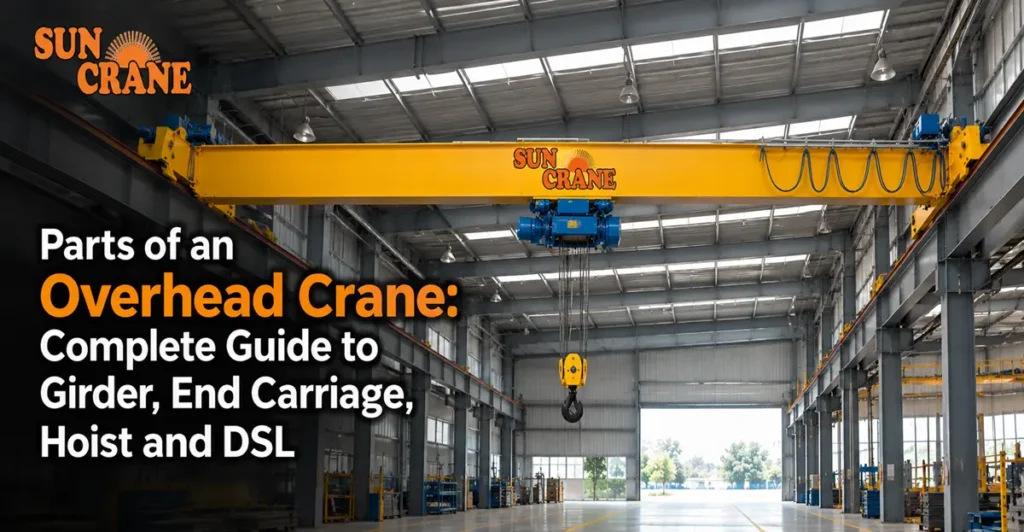
The main parts of an overhead crane are the bridge girder, the end carriages, the runway rails, the hoist, the trolley, the hook block, the power supply (DSL busbar or festoon), the controls and the safety devices. The girder spans the shed. The end carriages roll it along the runway. The trolley carries the hoist across the girder, and the hoist lifts the load.
This guide explains each of these overhead crane components in plain words: what it does, what usually goes wrong, and what to check before you buy or repair. It uses the terms Indian plants use every day, such as EOT crane, crab and DSL. For an overview of the machine itself, see the overhead crane page.
What Are the Main Parts of an Overhead Crane?
An overhead crane has three groups of parts. Structural parts (girder, end carriages, runway) carry the load and move the crane along the shed. Lifting parts (hoist, trolley, hook block) raise the load and move it across. Electrical parts (DSL, panel, pendant, limit switches) power and control every motion safely.
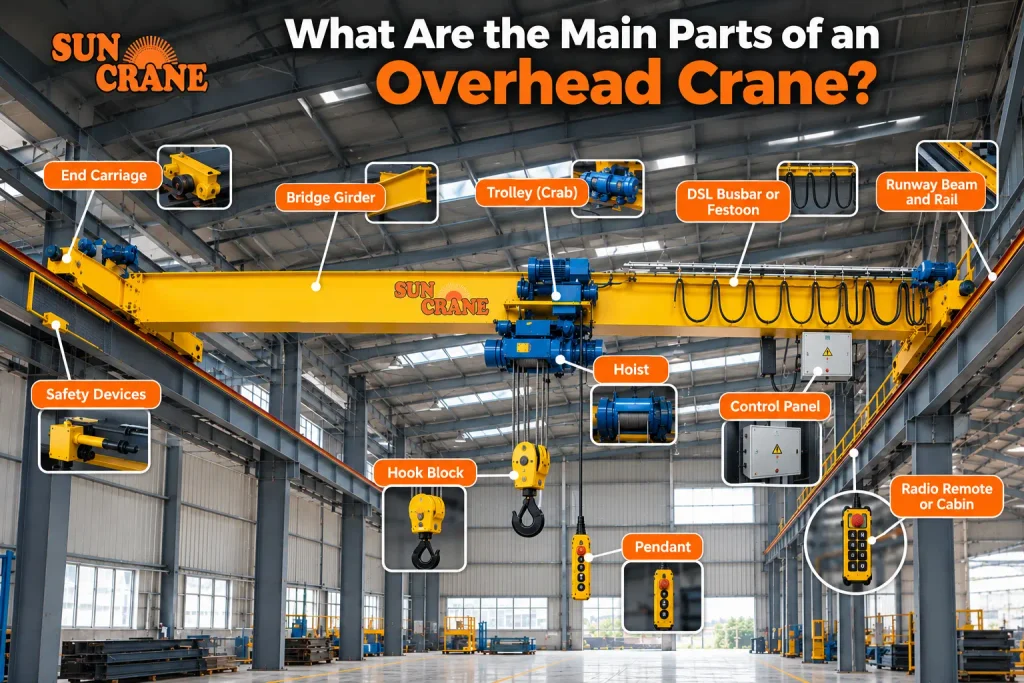
The table below lists the EOT crane parts names, what each one does and the first sign that it needs attention.
| Part | What it does | Common wear clue |
|---|---|---|
| Bridge girder | Spans the bay and carries the trolley and hoist | Cracks near welds, visible sag |
| End carriage | Holds the wheels and moves the crane along the runway (long travel) | Wheel flange wear, noisy drive |
| Runway beam and rail | Track for the end carriage wheels | Misaligned rail joints, loose clamps |
| Hoist | Lifts and lowers the load | Rope wear, load drifting down |
| Trolley (crab) | Carries the hoist across the girder (cross travel) | Jerky travel, worn wheels |
| Hook block | Connects the load to the rope | Hook opening up, missing safety latch |
| DSL busbar or festoon | Supplies power to the moving crane | Sparking, power cuts mid-travel |
| Control panel | Houses contactors, drives and protection | Overheating, burnt contacts |
| Pendant, radio remote or cabin | Lets the operator run the crane | Sticky buttons, damaged cable |
| Safety devices | Stop over-travel, overload and collisions | Limit switch fails to trip |
Practical tip: Before you call for spares, photograph the crane nameplate and the part’s own nameplate. Most delays come from ordering the wrong wheel diameter, rope size or motor rating.
Overhead Crane vs EOT Crane: Same Machine, Different Names
In India, most people say “EOT crane”. EOT stands for electric overhead travelling crane. Outside India you will also hear “bridge crane”, and bridge crane parts are the same as the ones in this guide. All three names describe the same machine.
The Indian code of practice, IS 3177, also uses the term EOT crane. Many Indian plants call the trolley of a double girder crane the “crab”. You will see both words in this guide.
A gantry crane uses most of the same parts. The difference is that it stands on its own legs instead of running on rails fixed to the building. So when you compare an “overhead crane” quote with an “EOT crane” quote, compare capacity, span, duty class and parts list, not the name.
Structural Parts: The Bridge and What Holds It Up
Bridge Girder: Single Girder vs Double Girder
The girder is the main beam that spans the bay from one runway rail to the other. The distance between the two rails is called the span. Girders are usually a fabricated box section or a rolled I-section.
A single girder EOT crane has one beam. The hoist hangs under it on a trolley that runs on the beam’s bottom flange. A double girder EOT crane has two beams. The crab runs on rails fixed on top of them, with the hoist between the girders.
| Feature | Single girder | Double girder |
|---|---|---|
| Hoist position | Hangs under the girder | Sits on a crab between the girders |
| Typical use | Light to medium loads, shorter spans | Heavier loads, longer spans, higher duty |
| Hook height | Lower, because the hoist uses headroom | Higher, because the hook can rise between the girders |
| Maintenance access | Usually no walkway | Walkway on the girder is possible |
| Weight and cost | Lower | Higher |
If your shed has a low roof, ask each supplier for a hook-height drawing, because a double girder crane can sometimes give more usable lift in the same building. A girder cannot be easily upgraded later, so plan for the load you expect in five to ten years. For a detailed comparison, read single girder vs double girder EOT crane.
End Carriage (End Truck): Wheels, Drives and Long Travel
End carriages sit at both ends of the girder. Each one holds the wheels that roll on the runway rails. Some wheels are driven by a motor and gearbox, and the others are idlers. Together they create long travel, the movement of the whole crane along the shed.
The drive can be one motor on each end carriage or one central motor with a long shaft. The wheels usually have flanges on both sides to keep them on the rail. Replace driven wheels in matched pairs, because wheels of different diameters make the crane run skew.
Practical tip: Look at the wheel flanges every month. If one side wears faster, the crane is running skew. Check rail alignment and drive speeds before changing wheels.
Runway Beams, Rails, Clamps and End Stops
The runway is the pair of beams along the building columns that carry the crane rails. Rail clamps hold the rails on the beams in line. End stops at each end of the runway stop the crane, and buffers on the end carriages absorb the impact.
In many Indian projects, the buyer’s civil or structural contractor builds the runway beams, not the crane maker. This is a common gap in quotations, so ask every supplier to state in writing who supplies the beams, rails, clamps and end stops. Misaligned rails are one of the most common causes of fast wheel wear.
Lifting Parts: Hoist, Trolley and Hook
Hoist: Wire Rope vs Chain Hoist
The hoist is the lifting machine. It has a motor, a gearbox, a brake and either a rope drum or a chain wheel. On most EOT cranes the hoist is electric.
A wire rope hoist winds steel rope on a grooved drum and suits medium to heavy loads and high lifts. A chain hoist pulls a load chain over a pocket wheel. It is compact and lower in cost, and suits lighter loads and shorter lifts. The choice depends on capacity, lift height and how often the crane works.
| Feature | Wire rope hoist | Chain hoist |
|---|---|---|
| Lifting medium | Steel wire rope wound on a grooved drum | Load chain over a pocket wheel |
| Capacity range | Medium to very heavy loads | Light to medium loads |
| Lift height | Suits high lifts | Suits short to medium lifts |
| Speed options | Single speed, dual speed or VFD | Single speed, dual speed or VFD |
| Main wear item | Wire rope and drum grooves | Load chain and chain wheel |
| Cost | Higher | Lower |
Practical tip: Choose the hoist by duty class (how often and how heavily it works), not only by capacity. A 5-tonne hoist used all day in a fabrication shop needs a higher duty class than one used twice a week in a store.
Trolley (Crab) and Cross Travel
The trolley carries the hoist across the girder. This movement is called cross travel. On a single girder crane, the trolley and hoist often come as one unit. On a double girder crane, the crab is a separate frame with its own wheels, motor, gearbox, rope drum and brake.
Do not run the trolley into the end of the girder at full speed. It shock-loads the buffers, the wheels and the load. Slow down near the ends, and do not use the limit switch as a routine stop.
Hook Block, Rope Drum, Gearbox and Brake
These parts sit inside or below the hoist:
- Hook block: the hook, its bearing and the rope sheaves (pulleys). It should always have a working safety latch.
- Rope drum and rope guide: a grooved drum winds and unwinds the wire rope evenly, and the rope guide keeps the rope in its grooves.
- Equaliser sheave: a sheave on the hoist that balances rope tension between the two rope falls on many wire rope hoists.
- Gearbox: reduces the high motor speed to a slow, strong output. See the reduction gearbox page for the types used on cranes.
- Brake: holds the load when the motor stops or power fails. Each motion has its own brake.
Check the gearbox oil level and look for leaks during monthly checks. A noisy or hot gearbox is an early warning, not something to ignore until the next shutdown.
Electrical Parts: Power Supply and Controls
What Is DSL in an EOT Crane?
DSL stands for Down Shop Lead. It is a set of conductor bars fixed along the runway that carry power to a moving EOT crane. A current collector on the crane slides along the bars and feeds the control panel. This lets the crane get power anywhere along the bay.
Older cranes often used bare conductors. Most new installations use a shrouded DSL busbar, where the conductors sit inside an insulated housing. This makes accidental contact much less likely. Indian suppliers list shrouded systems from about 60 A to 1,200 A. Ask the supplier to size the DSL on the total connected load and to check voltage drop on long runways [verify with your electrical consultant].
Mistake to avoid: Ignoring collector shoes in dusty shops. Worn or dirty collectors cause sparking and sudden power loss mid-travel.
DSL Busbar vs Festoon System: Which One Fits Your Shed?
Use a DSL busbar for long runways and frequent long travel, because it stays compact and needs no hanging cable. Use a festoon system, where flat cables hang in loops from small trolleys on a track, for short travel paths. The most common use is cross-travel power along the girder.
| Factor | DSL busbar | Festoon system |
|---|---|---|
| How power moves | Collector slides along fixed conductor bars | Flexible cable loops travel with the crane |
| Best suited to | Long travel along the runway | Cross travel and short runways |
| Space needed | Compact along the runway | Needs parking space for cable loops |
| Main wear parts | Collector shoes | Cables and cable trolleys |
| Watch-outs | Dust, heat and alignment | Cables can snag or get damaged in busy bays |
Many EOT cranes use both: DSL for long travel and festoon for cross travel. For short runs festoon is often simpler to install, while on long runways it needs a lot of cable and parking space. Get both options quoted for your actual runway length.
Control Panel, Pendant, Radio Remote and Cabin
The control panel holds the contactors, overload relays, MCBs and, on many new cranes, VFDs (variable frequency drives) for smooth starts and stops. It is the crane’s brain.
The operator runs the crane through one of these:
- Pendant control: a push-button box hanging from the crane on a cable. It is simple and low cost, but the operator must walk close to the load.
- Radio remote control: a handheld wireless transmitter. The operator can stand at a safer distance with a better view. It needs battery care and a backup plan if the signal fails.
- Cabin control: an operator cab fixed under the girder or at one end. It is used on large, high-lift or heavy-duty cranes where the operator rides with the crane.
Mistake to avoid: Choosing a radio remote and then operating from a spot where the load is out of sight. A remote improves safety only when the operator picks a clear, safe position.
Safety Devices on an Overhead Crane
Safety devices protect people, the load and the crane itself. A standard EOT crane should have:
- Hoist upper and lower limit switches: stop the hook before it hits the drum or unwinds too far.
- Long travel and cross travel limit switches: slow down or stop the crane and trolley near the ends.
- Overload protection: stops lifting when the load is above the rated capacity.
- Brakes on every motion: hold the load and stop travel when power is cut.
- Buffers and end stops: absorb impact at runway and girder ends.
- Anti-collision device: needed where two cranes share one runway; it slows or stops them before they meet.
- Emergency stop and main isolator: cut all motion instantly.
- Walkway and handrail: safe access for maintenance on double girder cranes.
- Warning horn or light: alerts people on the floor when the crane moves.
Practical tip: At the start of each shift, test the hoist upper limit at slow speed with no load. It takes one minute and catches a high-risk fault early.
How Do the Parts Work Together in One Lift?
Every overhead crane lift combines three motions: hoisting (up and down), cross travel (trolley across the girder) and long travel (whole crane along the runway). Power comes through the DSL to the panel, and the operator controls each motion from the pendant, remote or cabin while the brakes and limit switches keep it safe.
A typical lift happens in this order:
- The operator switches on the main isolator. Power flows through the DSL to the control panel.
- The hook is lowered and the load is slung and checked.
- The hoist lifts the load just clear of the floor, and the operator checks the brake holds.
- The trolley moves across the girder (cross travel).
- The end carriages move the whole crane along the runway (long travel).
- The hoist lowers the load gently at the new spot, using slow or micro speed.
| Motion | Parts involved | Indicative speed range [verify] |
|---|---|---|
| Hoisting | Hoist motor, gearbox, rope drum, brake, hook block | About 3 to 8 m/min [verify] |
| Cross travel | Trolley wheels, CT motor and gearbox | About 10 to 20 m/min [verify] |
| Long travel | End carriage wheels, LT motor and gearbox | About 20 to 40 m/min [verify] |
Mistake to avoid: Running two motions at full speed together with a swinging load. Finish the lift, let the load settle, then travel.
For more on how an EOT crane works and where it is used, read what is an EOT crane.
Which Overhead Crane Parts Wear Out First?
The parts that wear fastest are the ones that move, rub or carry load every cycle. These are the wire rope or chain, the brake linings, the wheels, the DSL collector shoes, the hook and the limit switches. Checking them on a fixed schedule prevents most breakdowns.
| Part | Warning signs | What to do |
|---|---|---|
| Wire rope | Broken wires, kinks, crushing, rust, reduced diameter | Replace as per the rope maker’s discard criteria and the applicable IS standard [verify standard number] |
| Brake lining | Load drifts down, longer stopping distance | Adjust or replace the lining |
| Wheels | Flange wear on one side, noise, skew travel | Check rail alignment; replace in matched pairs |
| DSL collector shoes | Sparking, power cuts while travelling | Replace shoes and clean the conductor bars |
| Hook | Throat opening up, twist, missing latch | Take out of service if deformed |
| Limit switches | Do not trip, or trip late | Repair before the next shift |
| Buffers | Cracked or hardened rubber | Replace |
| Gearbox | Oil leak, noise, high temperature | Top up oil, check bearings and seals |
| Pendant | Sticky buttons, damaged cable | Repair or replace |
Practical tip: Keep a small stock of critical spares: collector shoes, brake linings, limit switches, contactors and one spare pendant. These are cheap compared with a day of lost production.
IS 3177 and Inspection Basics for Indian Plants
IS 3177:2020 is the Indian code of practice for electric overhead travelling cranes and gantry cranes. Its scope covers design, manufacture, inspection and testing, and it supersedes IS 4137:2015 (BIS preview). The structural design of cranes and hoists is covered separately in IS 807.
IS 3177 classifies the crane as a whole in classes A1 to A8 and each mechanism in classes M1 to M8. This links each part’s design to how hard the crane will work. Load testing is done at commissioning, including an overload test where specified (commonly 25% above rated load) [verify against the current IS 3177 text].
On the legal side, the Factories Act, 1948 has been replaced by the Occupational Safety, Health and Working Conditions Code, 2020. Lifting machines must be examined periodically by a competent person. The exact interval and register format come from the applicable state OSH rules [verify for your state].
A simple inspection rhythm many plants follow:
- Every shift: operator checks on limits, brakes, hook latch, pendant and unusual noise.
- Monthly: maintenance checks of rope, wheels, collectors, gearbox oil and panel.
- Yearly or as required by law: thorough examination and certificate by a competent person [verify interval].
Mistake to avoid: Relying only on the load test certificate from commissioning. A crane that passed its test years ago can still have a worn rope today.
Overhead Crane Parts Checklist for Buyers
Use this list when you compare quotations for a new EOT crane or a major part replacement:
- Safe working load (SWL): the maximum load in tonnes.
- Span: the distance between runway rail centres.
- Lift height and hook approach: how high the hook goes and how close it gets to walls.
- Duty class: based on how many lifts per hour and how heavy they are.
- Girder type: single or double girder, and box or rolled section.
- Hoist type and speed control: wire rope or chain; single speed, dual speed or VFD.
- Power supply: DSL busbar or festoon, and the supply voltage at site (commonly 415 V, 3-phase, 50 Hz in Indian factories) [verify for your plant].
- Controls: pendant, radio remote, cabin or a combination.
- Safety devices: a written list of every limit switch, brake, overload and anti-collision device included.
- Standards: IS 3177 compliance stated in the quotation.
- Runway scope: who supplies the beams, rails, clamps and end stops.
- Spares and service: spare parts list, lead time and service response time.
Practical tip: Ask for a general arrangement (GA) drawing with every quote. It shows hook height, clearances and wheel loads on one sheet, and makes quotes easier to compare.
Key Takeaways
- An overhead crane has three groups of parts: structural (girder, end carriages, runway), lifting (hoist, trolley, hook block) and electrical (DSL, panel, controls, safety devices).
- Single girder cranes hang the hoist under one beam. Double girder cranes carry a crab on top of two beams and give more hook height.
- DSL means Down Shop Lead, a conductor bar system that powers a moving EOT crane. Festoon cables usually power cross travel or short runs.
- Cranes are run by pendant, radio remote or cabin; the right choice depends on load, lift height and where the operator can stand safely.
- Wire ropes, brake linings, wheels, collector shoes, hooks and limit switches wear out first and need regular checks.
- IS 3177:2020 is the Indian code of practice for EOT and gantry cranes, and IS 807 covers their structural design.
- Always confirm the runway scope and spare parts support before you place an order.
FAQs
Can a single girder crane carry two hoists?
It is possible in some designs, but the girder, end carriages and controls must be designed for it from the start. Adding a second hoist to an existing crane needs a fresh design check by the crane maker. Never add one without that check.
How often should a wire rope on an EOT crane be checked?
Operators should look at the rope at the start of every shift for obvious damage. A closer check by maintenance staff is usually done monthly, and a competent person examines it during the periodic statutory inspection. Heavy-duty cranes may need more frequent checks [verify].
Can a pendant control be upgraded to a radio remote?
Yes, most EOT cranes can be fitted with a radio remote receiver that connects to the existing control panel. Many plants keep the pendant as a backup. Ask the crane maker to check that the panel and safety circuits suit the remote.
When does an EOT crane need a cabin instead of a pendant?
A cabin suits cranes with high lifts, long spans, heavy or hot loads, or very frequent use, where walking under the load is unsafe or slow. It gives the operator a fixed view from above. Most light and medium workshop cranes do not need one.
What does an anti-collision device do on an EOT crane?
It senses the distance between two cranes on the same runway, or between a crane and an end stop. It first slows the crane, then stops it before impact. It is needed wherever two or more cranes share one runway.
What is hook approach on an overhead crane?
Hook approach is the closest distance the hook can reach to the side walls or runway ends. A smaller hook approach means more usable floor area. It depends on the end carriage, trolley and hoist design, so compare it on each supplier’s GA drawing.
Final Thoughts on Overhead Crane Parts
Knowing the parts of an overhead crane makes every decision easier, from writing a purchase specification to finding why the crane stops mid-travel. Each part has a clear job, and most problems show early warning signs if someone looks.