
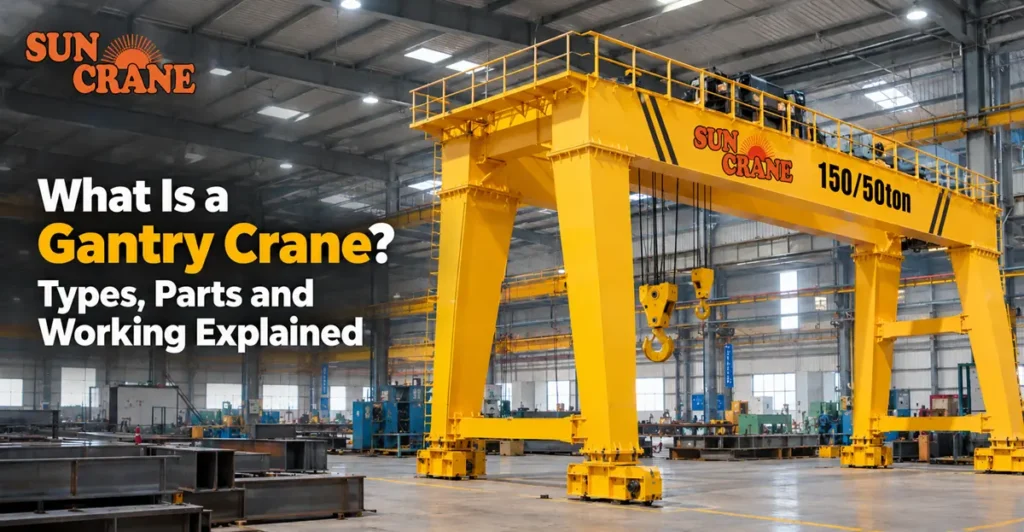
Need to lift heavy material in an open yard, or in a shed whose roof cannot carry a crane? That is where a gantry crane fits. It carries its own girder on two legs, so it stands on the ground instead of hanging from a building.
This guide covers what a gantry crane is, how it works, the parts names, types, uses, safety rules and price in India, in simple words for plant managers, fabricators and yard operators.
What Is a Gantry Crane?
A gantry crane is a lifting machine in which a horizontal girder is supported by two legs that stand on the ground or on rails, not on a building. A trolley and hoist travel along the girder to lift and move loads, so the crane covers a rectangular working area.
How it differs from other cranes
- Overhead (EOT) crane: runs on beams fixed to the building. A gantry crane needs no building support.
- Jib crane: swings in an arc around a fixed post. A gantry crane covers a straight-line, rectangular area.
- Mobile crane: drives to the job on a truck or chassis. A gantry crane works over a set track or area, often for years.
Four basic elements
- Girder (bridge): spans the work area
- Two legs: carry the girder
- Trolley and hoist: run along the girder
- Travel base: rails, wheels or rubber tyres
“Gantry” means a frame that straddles something. The crane straddles the load, the truck or the work area, and lifts from above.
Sizes vary widely. A small portable gantry may lift 500 kg in a workshop. A large rail-mounted one in a shipyard can lift hundreds of tonnes.
How Does a Gantry Crane Work?
A gantry crane lifts a load with a hoist, moves it sideways with a trolley along the girder, and carries it forward or backward by travelling on rails or tyres. This is the gantry crane working principle: three motions that together place the load at any point inside the crane’s rectangular working area.
| Motion | What moves | Direction |
|---|---|---|
| Hoisting | Hook, rope or chain | Up and down |
| Cross travel | Trolley with hoist | Across the span, along the girder |
| Long travel | Whole crane on its legs | Along the yard or shop length |
Step by step
- The operator gives a command from a pendant, radio remote or cabin.
- The hoist motor turns the drum and the hook goes down to the load.
- The load is slung and lifted.
- The trolley moves along the girder to line up over the drop point.
- The crane travels on its rails or tyres to the new location.
- The load is lowered and the sling is released.
The usual supply in India is 415 V, 3-phase, 50 Hz. Outdoor cranes commonly take power through a cable reel or a conductor bar system.
Gantry Crane Parts Names: What Are the Main Parts?
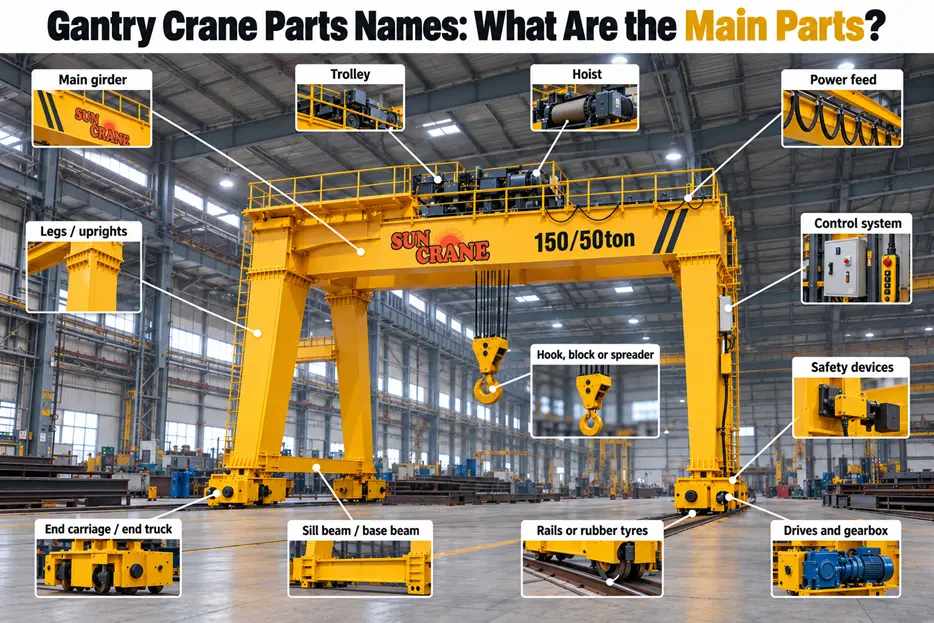
The gantry crane main parts are the girder, two legs, end carriages with travel wheels, a trolley, a hoist with hook, drives and gearboxes, a control system and safety devices. The structure holds the load, the mechanisms move it, and the electrical system controls it.
| Part | What it does |
|---|---|
| Main girder (single or double) | Horizontal beam that carries the trolley and the load |
| Legs / uprights | Carry the girder down to the ground |
| End carriage / end truck | Frame at the base of each leg that holds the travel wheels |
| Sill beam / base beam | Beam joining the leg to the wheels (used in some full gantry designs) |
| Rails or rubber tyres | The path the crane travels on |
| Trolley | Carries the hoist across the girder |
| Hoist (wire rope or chain) | Lifts and lowers the load |
| Hook, block or spreader | Holds the load; spreaders suit long items and containers |
| Drives and gearbox | Motors and reduction gearboxes for hoisting and travel |
| Control system | Panel, pendant, radio remote or operator cabin |
| Power feed | Cable reel, festoon or conductor bar |
| Safety devices | Limit switches, overload limiter, buffers, rail clamps, wind gauge |
Gantry crane parts differ a little between designs. Single girder cranes usually have one beam with an electric hoist hanging below it. Double girder cranes have two beams with the trolley on top, which suits heavier loads and higher lifts.
What Are the Types of Gantry Cranes?
Gantry crane types are grouped by girder (single, double, truss), by support (full, semi-gantry, portable, cantilever) and by use (rail-mounted RMG, rubber-tyred RTG, goliath, container). Single girder suits lighter work, double girder suits heavier loads and wider spans, and RMG or RTG types serve yards and ports.
By girder
- Single girder gantry crane: One main beam. Lighter, cheaper and quicker to install. Common in workshops, stores and light yards.
- Double girder gantry crane: Two beams with the trolley on top. Gives more lifting height, wider spans and heavier capacity. Used in steel yards, precast yards and shipyards.
- Truss girder gantry crane: The girder is a lattice truss. It is lighter over long spans and lets wind pass through, so it suits long outdoor spans.
By support
- Full gantry crane: Both legs run on the ground or on ground rails.
- Semi-gantry crane: One leg runs on the ground. The other side runs on a rail fixed to a wall or building column. This saves floor space inside a shed.
- Portable / adjustable gantry crane: A small frame, often on castor wheels, with adjustable height or span. Used for workshops and maintenance jobs.
- Cantilever gantry crane: The girder extends past the legs on one or both sides. Useful for loading trucks or reaching over a storage bay.
By use
- Rail-mounted gantry crane (RMG): Runs on fixed rails. Common in container yards, rail terminals and steel yards.
- Rubber-tyred gantry crane (RTG): Runs on tyres, so it can move between container stacks without rails.
- Goliath crane: A very large full gantry for shipyards and heavy fabrication.
- Container gantry crane (ship-to-shore): Quay cranes that load and unload ships. A much larger, special class.
Typical capacity by type (indicative)
| Type | Typical capacity | Usual setting |
|---|---|---|
| Portable gantry | About 0.5 to 5 t | Workshops, maintenance bays |
| Single girder gantry | About 1 to 20 t | Workshops, stores, light yards |
| Double girder gantry | About 10 t to 200 t and above | Steel yards, precast yards, shipyards |
| RMG / RTG | Project specific | Container yards, terminals |
Limits differ by manufacturer and design. Treat these as a guide and confirm with the maker [verify].
What Is a Gantry Crane Used For?
A gantry crane is used to lift and move heavy items in open yards, outdoor storage, fabrication shops, precast yards, shipyards and ports. It is chosen where a building cannot support an overhead crane, or where loads must be handled outside, such as loading trucks in a steel stockyard.
Common uses in India:
- Fabrication and engineering workshops: plates, beams, dies and machined parts
- Steel yards and stockyards: coils, bars, pipes and structurals onto trucks
- Precast concrete yards: beams, slabs and moulds
- Shipyards and boat building: hull blocks and engines
- Container yards and rail terminals: RMG and RTG stacking
- Power, cement and infrastructure projects: heavy equipment during erection
- Warehouses and godowns: truck loading and unloading
Gantry Crane vs Overhead Crane: What Is the Difference?
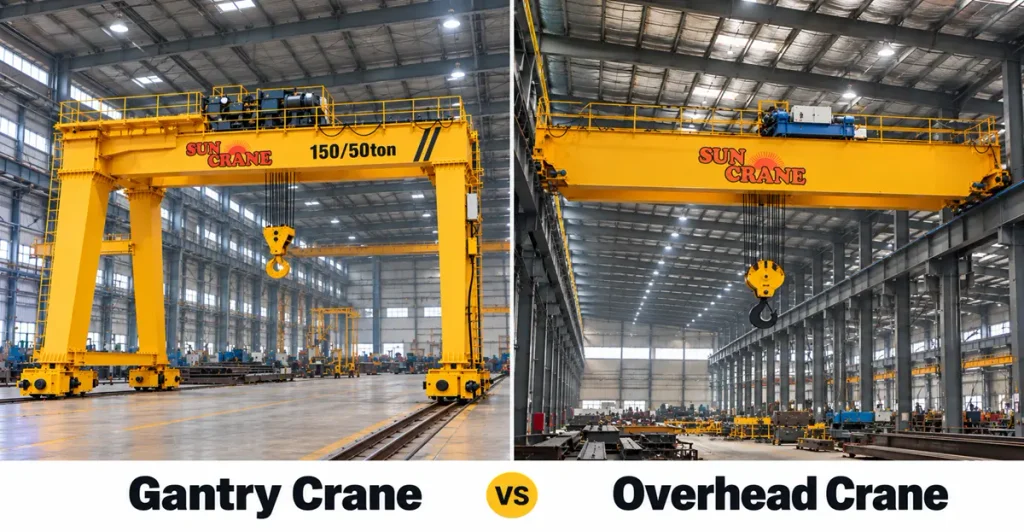
A gantry crane stands on its own legs and travels at ground level, while an overhead (EOT) crane runs on raised runway beams fixed to the building’s columns. Gantry cranes suit outdoor or open areas. EOT cranes suit covered, permanent shops.
| Point | Gantry crane | Overhead (EOT) crane |
|---|---|---|
| Support | Own legs on the ground | Runway beams on building columns |
| Best location | Outdoor yards, open bays, sheds with weak roofs | Inside buildings designed for it |
| Floor space | Legs and rails use ground space | Floor stays free |
| Building need | None | Building must be designed for crane load |
| Mobility | Portable, rail or tyre mounted | Fixed to its runway |
| Weather | Needs wind and rain protection | Mostly sheltered |
| Civil work | Ground rail foundation | Strong columns and runway |
Many plants use both: an EOT crane inside the shop and a gantry crane in the yard.
Advantages and Limitations
Advantages
- Does not depend on the building structure
- Works outdoors and in existing sheds with weak roofs
- Available as portable, rail-mounted or tyre-mounted
- Wide range of capacity and span
Limitations
- Legs and rails take ground space
- Outdoor use brings wind, rain and corrosion issues
- Rail-mounted types need a proper foundation and level rails
- Long spans and tall legs need careful stability design
- Rubber-tyred types need firm, level ground
What Safety Devices and Rules Apply in India?
Common safety devices:
- Hoist limit switches (upper and lower)
- Overload protection (load limiter)
- Travel limit switches and buffers
- Rail clamps or storm anchors on outdoor cranes
- Anemometer (wind gauge) with alarm or cut-off on outdoor cranes
- Emergency stop and warning siren or light
- Rail sweeps to clear debris from the track
Standards and law:
- IS 3177:2020 is the BIS code of practice for electric overhead travelling cranes and gantry cranes. It replaced IS 3177:1999 and IS 4137:2015.
- Wind load on outdoor structures is usually checked against IS 875 (Part 3) [verify with your designer].
- Under Section 29 of the Factories Act, 1948, every lifting machine must be thoroughly examined by a competent person at least once in every period of twelve months, or at intervals the Chief Inspector specifies in writing. A register of examinations must be kept. State Factories Rules add details.
Monsoon note: For yard cranes, check rail drainage, rail clamps and cable reel condition before the rains. Water around rails and foundations is a common source of trouble.
Basic pre-use checks
- Hook, latch and wire rope or chain
- Brakes and limit switches
- Rails, wheels and rail clamps
- Pendant or remote, and emergency stop
- Clear path, with no one under the load
How to Choose a Gantry Crane: 8 Checks
- Capacity: heaviest load, plus slings, magnets or spreaders
- Span: distance between the two rails, centre to centre (not leg to leg)
- Lifting height: hook height needed, including clearance under the load
- Duty class: how often and how heavily it works
- Indoor or outdoor: outdoor needs wind design, rail clamps and weather protection
- Rail-mounted or rubber-tyred: rails give precision, tyres give flexibility
- Control type: pendant, radio remote or cabin
- Power and site: 415 V, 50 Hz supply, ground condition, rail foundation, cable route
Keep a simple layout sketch, load list and duty cycle ready. Any manufacturer will need them to design correctly.
What Is the Price of a Gantry Crane in India?
A single girder gantry crane typically costs about ₹4 lakh to ₹16 lakh, a double girder crane about ₹8 lakh to ₹25 lakh for 5 to 20 tonnes, and a portable gantry about ₹0.5 lakh to ₹5 lakh. Large 50-tonne double girder cranes start near ₹85 lakh. Capacity, span, height and duty class drive the final price.
| Type | Indicative range (2026) |
|---|---|
| Portable gantry (about 1 to 5 t) | ₹0.5 lakh to ₹5 lakh |
| Single girder gantry (about 2 to 15 t) | ₹4 lakh to ₹16 lakh |
| Double girder gantry (about 5 to 20 t) | ₹8 lakh to ₹25 lakh |
| Large double girder (around 50 t) | ₹85 lakh to ₹1.4 crore or more |
| Rubber-tyred gantry (container yards) | ₹1 crore and above, project priced [verify] |
Indicative only, based on public Indian supplier listings checked in October 2026. Excludes GST, foundation, freight and erection unless stated. Supplier quotes vary widely.
Key Takeaways
- A gantry crane is self-supporting: a girder on two legs, with a trolley and hoist.
- It has three motions: hoisting, cross travel and long travel.
- Main parts: girder, legs, end carriages, trolley, hoist, drives, controls and safety devices.
- Types are grouped by girder, by support and by use.
- Choose a gantry over an EOT crane when work is outdoors or the building cannot take crane load.
- Outdoor cranes need wind protection, rail clamps and a yearly examination by a competent person.
- Capacity, span, height, duty class and site conditions decide the design and cost.
FAQs
Should I choose a single girder or a double girder gantry crane?
Choose single girder for lighter loads, shorter spans and a few lifts a day. It costs less and is easier to install. Choose double girder for heavier loads, wider spans, higher hook height or frequent lifting, because it is stronger and gives more room for the hoist.
Gantry crane or jib crane: which is better for my yard?
A jib crane suits small loads in a circular area around one post or wall. A gantry crane suits a long, rectangular area and heavier loads, such as a stockyard or a loading bay. If you only serve one machine or bay, a jib crane is usually enough.
What is duty class and why does it matter?
Duty class describes how often and how heavily a crane works. Two 10-tonne cranes can need different motors, gearboxes and structure if one lifts a few times a day and the other works all shift. Tell the maker your lifts per hour and typical load.
Does a gantry crane need a foundation?
Rail-mounted cranes need a level, properly designed rail track and foundation. Rubber-tyred and portable cranes need firm, level ground. Soft or uneven soil can cause tilting, rail wear and misalignment, so site soil conditions should be checked before ordering.
Can a gantry crane be shifted to another location?
Portable and tyre-mounted cranes can be moved easily. Rail-mounted cranes can be dismantled and re-erected, but the rails and foundation must be built again at the new site. Plan the move with the manufacturer, since the structure must be rechecked.
Is a gantry crane cheaper than an EOT crane?
Not always. A gantry crane avoids strengthening a building or building runway columns, but it needs rails, a foundation and weather protection. For a new open yard it is often the practical choice. For a covered shop, compare both on total installed cost.
Conclusion
A gantry crane gives you overhead lifting without needing a building to hold it up. That makes it a practical choice for yards, open bays and sheds where an EOT crane is not possible. Knowing the parts, types and safety needs helps you describe your requirement clearly and compare quotations fairly.
Before you approach any supplier, note your heaviest load, span, lifting height, duty cycle and site layout. For more on options, see gantry crane models or the jib crane vs gantry crane comparison.