Every factory, warehouse and fabrication unit reaches a point where manual material handling becomes slow, unsafe and expensive. That is when an industrial crane enters the picture. But with so many types available – EOT, HOT, gantry, jib, monorail, hoists – most buyers struggle with one simple question: which crane is right for my work?
This guide explains all the major industrial crane types, where each one is used, the capacity ranges they come in, what they cost in India, and the seven factors you should check before making a final decision. By the end, you will be able to shortlist the right crane for your facility with confidence.
What is an Industrial Crane?
An industrial crane is a machine that picks up heavy material and moves it from one point to another – up, down, left, right – inside your factory, warehouse or yard. Anything that is too heavy or too risky for workers to lift by hand, the crane does that job all day, every day, without getting tired.
These cranes are fixed at your workplace, unlike the mobile cranes you see on construction sites that come and go. And why do factories install them? Three simple reasons: work gets done faster with fewer people, material does not get damaged while shifting, and your workers stay at a safe distance from heavy hanging loads.
Main Types of Industrial Cranes and Their Uses
1. EOT Crane (Electric Overhead Travelling Crane)
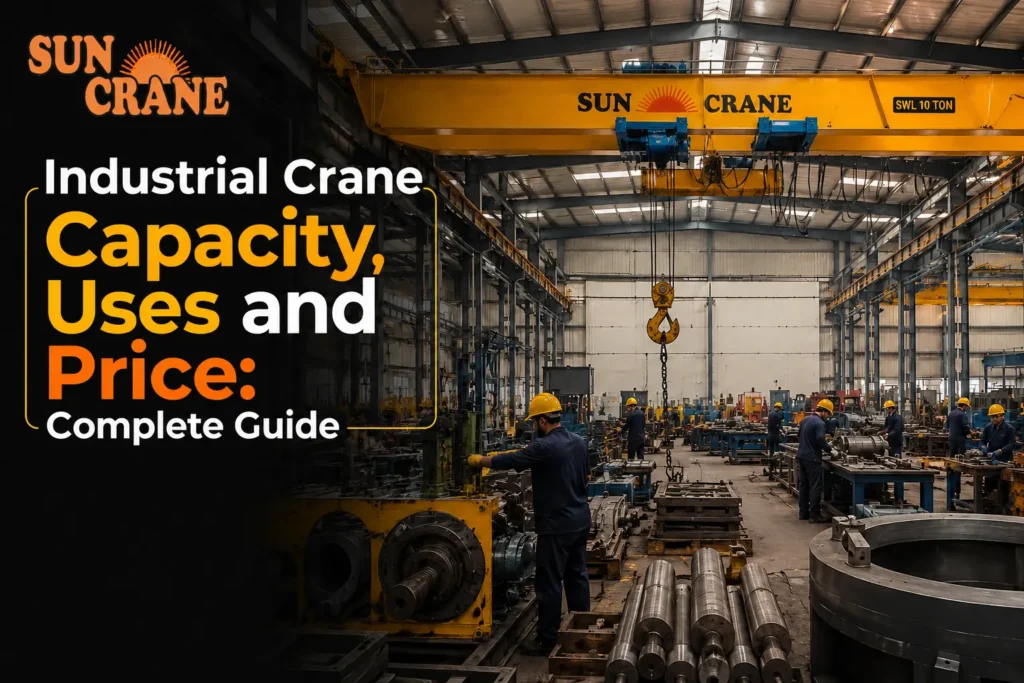
The EOT crane is the workhorse of Indian industry. It travels on rails fixed along the length of the building, with a hoist trolley moving across the span, so it covers the entire shop floor area. EOT cranes come in two designs:
- Single girder EOT crane – one bridge beam, economical, ideal for loads up to around 10-15 ton.
- Double girder EOT crane – two bridge beams, higher lifting height and stability, suited for 10 ton to 50 ton and above.
Typical users include engineering workshops, chemical plants, foundries and warehouses. If you are confused between the two designs, read our detailed single girder vs double girder comparison, or explore the complete EOT crane range here.
2. HOT Crane (Hand Operated Travelling Crane)
A HOT crane looks like an EOT crane but is operated manually through chain pulleys instead of electric motors. It suits units with lighter loads, occasional lifting or unreliable power supply. HOT cranes cost much less than EOT cranes and need almost no maintenance, which makes them popular in small fabrication shops and godowns.
3. Gantry Crane
A gantry crane carries its bridge on two legs that travel on rails laid on the ground, so the building structure carries no load. This makes it the first choice for open yards, ports, pipe yards and pre-engineered buildings that cannot support overhead rails. Semi-gantry versions run one side on an elevated rail and one side on the floor. You can see the gantry crane options here.
4. Jib Crane
A jib crane serves a circular area around a fixed pillar or a wall-mounted arm, typically rotating 180 to 360 degrees. It is perfect for individual workstations – loading a machine, serving an assembly bench or supporting a welding bay – where a full overhead crane would be wasteful. Capacities usually range from 250 kg to 5 ton. Jib crane details are available here.
5. Monorail Crane
A monorail system runs a hoist along a single fixed I-beam path, moving material along a production line or between two fixed points. It is the right answer when your material always travels the same route, such as from a machining section to an assembly section.
6. Wire Rope Hoist and Chain Hoist
Hoists are the lifting units that power most cranes, and they are also used independently on monorails and jib arms. Wire rope hoists handle higher capacities and faster, more frequent lifting; chain hoists are compact and economical for lighter loads.
7. Chain Pulley Block
The simplest and most affordable lifting equipment – a manual chain block used with tripods, beams or HOT cranes for occasional lifting from 0.5 ton to 20 ton.
Industrial Crane Capacity Guide
Use this table as a quick reference for matching crane type to load range:
Crane type | Typical capacity | Coverage | Best suited for |
Single girder EOT | 1 – 15 ton | Full shop floor | Workshops, warehouses |
Double girder EOT | 10 – 50+ ton | Full shop floor | Heavy engineering, foundries |
HOT crane | 0.5 – 10 ton | Full shop floor | Light, occasional lifting |
Gantry crane | 1 – 50 ton | Open yard | Yards, ports, PEB sheds |
Jib crane | 0.25 – 5 ton | Circular area | Single workstations |
Monorail | 0.5 – 10 ton | Fixed path | Production lines |
Chain pulley block | 0.5 – 20 ton | Fixed point | Maintenance, erection jobs |
Industrial Crane Price in India
Crane pricing depends mainly on four things: type, capacity, span and duty class. The table below gives indicative starting ranges so you can plan your budget. Treat these as ballpark figures – the final quotation always depends on your exact specifications.
Crane type | Indicative price range | Biggest price drivers |
Chain pulley block | Rs. 10,000 – 1.5 lakh | Capacity, chain grade |
Jib crane | Rs. 1 – 5 lakh | Arm length, rotation, hoist type |
HOT crane | Rs. 2.5 – 8 lakh | Capacity, span |
Single girder EOT | Rs. 4 – 15 lakh | Capacity, span, duty class |
Double girder EOT | Rs. 10 – 50 lakh+ | Capacity, span, duty class, height |
Gantry crane | Rs. 6 – 40 lakh | Capacity, span, outdoor duty |
Remember that purchase price is only part of the story – installation, load testing, spares and annual maintenance decide the real cost of ownership over a 15-20 year crane life. A tonnage-wise EOT crane cost breakdown is covered separately later in this guide’s linked resources.
7 Factors to Check Before Selecting an Industrial Crane
- Indoor or outdoor duty – indoor sheds suit EOT and HOT cranes; open yards need gantry cranes with weather protection.
2. Load capacity with margin – take your heaviest load, add tackle weight, and keep 20-25 percent margin for future needs.
3. Span and lifting height – measure the building width between rail centres and the highest point the hook must reach.
4. Duty class – how many lifts per hour? Class II suits light duty, Class III regular production, Class IV continuous heavy duty. The wrong class is the most common and costliest selection mistake.
5. Power availability – stable three-phase supply favours EOT cranes; erratic supply or rare usage favours HOT cranes and chain blocks.
6. Safety standards – insist on IS 3177 and IS 807 compliant design, load testing certificates and limit switches as standard.
7. Total lifecycle cost – compare maintenance, spares availability and service support, not just the quotation amount. Our EOT crane price breakdown explains what actually drives crane pricing.
Which Crane Should Your Industry Choose?
Chemical and pharma plants: single girder EOT cranes with dust or flameproof options.
- Heavy engineering and foundries: double girder EOT cranes, Class III or IV duty.
- Warehouses and logistics: single girder EOT or HOT cranes depending on lifting frequency.
- Open stockyards and PEB structures: gantry or semi-gantry cranes.
- Machine shops and assembly bays: jib cranes at each workstation, supported by a monorail line.
Conclusion
Selecting an industrial crane is really a sequence of four decisions: where it will work (indoor or outdoor), how much it must lift (capacity and margin), how often it will run (duty class), and what it must comply with (IS standards). Get these four right and the type of crane almost selects itself.
If you are still unsure, share your load, span and building details with an experienced industrial crane manufacturer in Gujarat like Sun Crane. Our team inspects your site, recommends the right configuration and handles manufacturing, installation and after-sales support under one roof.