
Two suppliers can quote the same 10 ton EOT crane with a ₹6-8 lakh gap between them, and both quotations can be technically correct. The difference sits in span, duty class, girder type, and the electrical configuration underneath – none of which appear in the headline number.
An EOT crane (Electric Overhead Travelling crane) is a bridge-type lifting system that runs on runway beams fixed to your building’s columns, covering the entire floor area beneath it. Prices in India range from around ₹3.5 lakh for a 1 ton single girder unit to ₹1.4 crore or more for a 50 ton double girder installation.
This guide covers the decisions that actually determine what you pay and how long the crane lasts: what an EOT crane is, how it works, its parts, the type options, honest capacity sizing, real price bands, and the safety scope that quietly disappears from cheap quotations.
New to crane selection altogether? Start with our industrial crane types and capacity guide to confirm an EOT crane is the right category for your facility, then come back here.
What Is an EOT Crane?
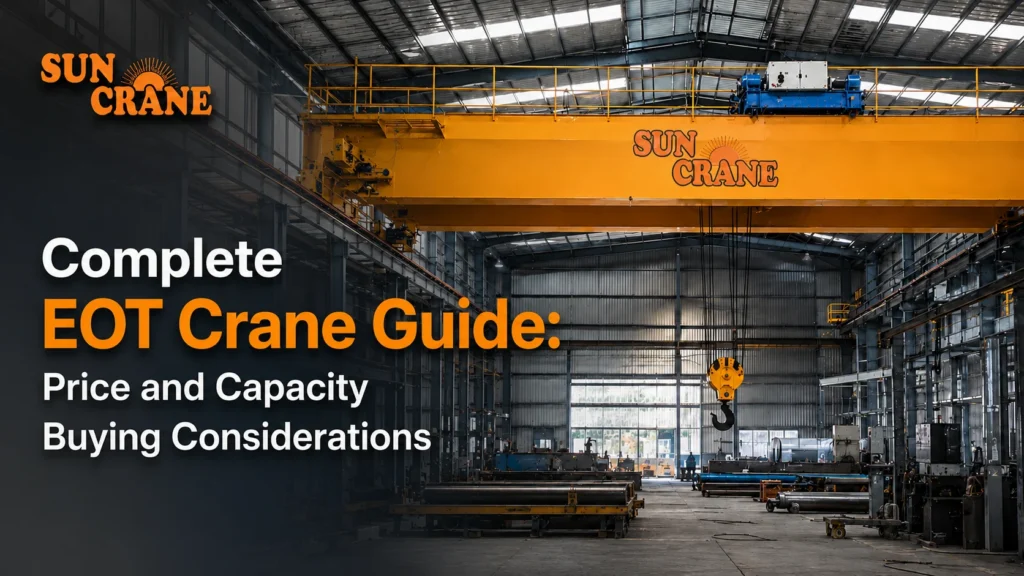
An EOT crane consists of a bridge girder – single or double – spanning two parallel runway beams mounted on your building structure. A hoist travels across the bridge (cross travel), the bridge travels along the runway (long travel), and the hoist lifts and lowers. Three motions, all electrically driven, all controlled by one operator from a pendant, radio remote, or cabin.
The travelling element is what separates it from a fixed hoist on an I-beam. An EOT crane puts the hook almost anywhere in the rectangle under the runway.
In India, EOT cranes are designed under IS 3177 (mechanical, electrical, duty classification) and IS 807 (structural design), with IS 4137 covering heavy-duty mill-type cranes in foundries and steel plants. General industrial capacities run from 0.5 ton to 200+ tons, with spans typically up to 32 metres. Beyond that span, a gantry crane becomes the practical option.
They are the default across automotive plants, textile mills, fabrication shops, pharma, cement, and general engineering – not because they are sophisticated, but because nothing else covers a rectangular bay this efficiently.
How Does an EOT Crane Work?
Power reaches the crane through a Downshop Line (DSL) – usually a four-line shrouded busbar running the length of the runway, with collectors on the crane picking up current. From there, three independent drive systems do the work.
Hoisting motion. A hoist motor drives a gearbox, which turns a rope drum. Wire rope spools onto the drum, runs through a sheave block, and lifts the hook. An electromagnetic brake holds the load the instant power drops. Hoisting is the slowest of the three motions by design – you want control, not speed, when the load leaves the ground.
Cross travel. The trolley – or crab, on a double girder – moves along the bridge girder on wheels, driven by a CT motor and gearbox.
Long travel. End carriages at both ends of the bridge carry the LT wheels. On wider spans, twin drives at both ends prevent the bridge from skewing on the rails. Worth confirming in any quotation above 15 metres of span.
Everything terminates at limit switches: upper and lower hoist limits, LT and CT end limits, and anti-collision sensors where two cranes share a runway.
Where crane life is actually decided: control type. A crane running direct-on-line contactor control shock-loads the rope and hammers the gearbox on every start. VFD control on all three motions ramps speed smoothly, cuts load swing, and meaningfully extends drivetrain life in a plant running frequent cycles. It costs more upfront. Above M5 duty, it usually earns that back.
EOT Crane Parts: What You Are Actually Paying For
When two quotations at the same tonnage differ by 30 percent, the difference is buried in this list.
| Part | Function | What to check in a quote |
|---|---|---|
| Bridge girder | Main load-carrying beam spanning the runway | Box girder vs I-beam; plate thickness; camber |
| End carriages | Carry the bridge along the runway | Wheel material, bearing type, twin vs single drive |
| Hoist / crab unit | Lifts and lowers the load | Branded vs unbranded; duty rating of the hoist itself |
| Wire rope | Transmits lift force from drum to hook | Make, construction (6×36), diameter |
| Rope drum & sheaves | Spool and route the rope | Groove machining; single vs multi-layer spooling |
| Hook block | Load attachment point | Forged vs cast; swivel; safety latch |
| Motors (hoist/CT/LT) | Drive all three motions | Make, IP rating, insulation class, duty rating |
| Reduction gearboxes | Reduce speed, increase torque | Helical vs worm; make; oil-bath sealing |
| Brakes | Hold load and stop motion | Electromagnetic thrustor vs DC disc; lining life |
| LT / CT wheels | Run on rails | Forged vs cast steel; hardness; flange wear allowance |
| DSL / busbar | Power supply along runway | Shrouded vs open; current rating |
| Control panel | Contactors, VFDs, protection | IP rating, component makes, VFD vs DOL |
| Pendant / remote | Operator interface | IP65 pendant; radio remote frequency |
| Limit switches | Motion safety cutoffs | How many are included – cheap quotes skip CT/LT limits |
| Runway rails | Track for LT wheels | Frequently excluded from crane scope – confirm |
Two cranes both rated 10 ton can differ by several lakh purely on hoist brand, gearbox type, and whether VFDs sit in the panel. Ask for a component makes list with every quotation. A supplier who will not provide one has told you something useful.
EOT Crane Types: Which Configuration Fits Your Bay?
The type decision is settled by three things – capacity, span, and headroom.
Single Girder EOT Crane
One bridge girder with the hoist suspended below. Lighter dead weight means less load on your building structure, less headroom, and a cheaper crane. Single girder is marketed up to 15 tons, but most manufacturers stop recommending it above 10 tons – and at 10 ton it stays viable to roughly 15–16 metres of span. Right for machine shops, assembly bays, tool rooms, and warehouses. Full specification: single girder EOT crane.
Double Girder EOT Crane
Two girders with the crab travelling on top. The hook rises between the girders, so you get more lift height from the same building height, plus better hook approach, higher capacity, and a maintenance walkway. This is the choice above 10 tons, beyond 15–16 metre spans, or when duty class pushes past M5. It costs 40–60 percent more at the same capacity, which is justified only when span, duty, or lift height genuinely require it. See double girder EOT crane, or our single vs double girder comparison for the full decision.
Top Running vs Underslung
Top running cranes carry LT wheels on rails sitting on top of the runway beams – the standard configuration. Underslung cranes hang from the bottom flange of the runway beam, useful where there are no columns to mount a runway on. Underslung suits light capacities, but there is no universal tonnage cutoff; the real limit is what your roof structure can carry, so it always needs structural verification first.
Semi-EOT and Related Options
- Semi-EOT: one or more of the three motions is manual, usually cross or long travel via chain pull. Cheaper, and adequate for low-frequency lifting. IS guidance assumes a sustained operator pull of 250N, which practically limits it to light cranes.
- Monorail: single-axis hoist on a fixed beam. Not a true EOT crane, but frequently the right answer when your material always travels the same route.
- Hot crane: for foundries and high-temperature environments, built to IS 4137 with heat-shielded components.
- Semi-gantry: one leg on ground rail, one end on a runway beam. The practical middle ground where a bay is open on one side or extends outdoors.
EOT Crane Capacity: Sizing It Without Overpaying or Under-Buying
This is where buyers go wrong most often, in both directions.
Start from your heaviest single lift, including the tackle. Not the load. The load plus the lifting beam, slings, magnet, grab, or C-hook. A 4.2 ton casting on a 400 kg lifting beam is a 4.6 ton lift, and a 5 ton crane has 400 kg of headroom left. Under IS 3177, safe working load includes attachments.
Then size for five years out, not today. Upgrading capacity later means a new girder, new hoist, and often new runway beams – effectively a new crane. If you are genuinely between two capacities, size up. A crane running consistently near its rated capacity wears faster and costs more across its life.
Do not confuse duty class with a safety factor. This is the most common misunderstanding in the market. A 5 ton M7 crane is not a 6 ton crane. Duty class defines how many hours and cycles the crane is designed to survive, not how much it can lift. IS 3177 requires load testing at 125 percent SWL, but that is a one-time proof test, not an operating allowance. A 5 ton crane lifts 5 tons.
Duty Class Selection (IS 3177 / IS 807)
| Duty Class | Old Class | Working hrs/day | Design life (hrs) | Typical application |
|---|---|---|---|---|
| M1–M3 | Class I | 0.5–1 | 400–1,600 | Standby, tool rooms, low-batch workshops |
| M4–M5 | Class II | 4–6 | 3,200–6,300 | General engineering, machine shops, medium production |
| M6 | Class III | 6–9 | 25,000 | Logistics yards, warehouse hubs, fabrication units |
| M7 | Class IV | 6–9 | 35,000 | Continuous production, heavy fabrication |
| M8 | Class IV | 12+ | 75,000 | Steel plants, foundries, cement, round-the-clock ops |
Older quotations still use the Class I to Class IV system. IS 3177:2020 replaced it with M1–M8, and the mapping above is what your supplier should be working to. If a quote says Class III and you were expecting M6, they mean the same thing.
Look at the jump between M5 and M6 – 6,300 hours to 25,000. That is not incremental. A plant genuinely running two shifts on an M5 crane hits end-of-life in roughly a third of the expected time, and the failure looks like poor quality when it was a specification error made at PO stage.
The reverse is equally expensive. Specifying a higher duty class “for safety” in a light-duty application means paying for hours you will never use. A properly selected M3 or M4 crane serves a standard fabrication shop reliably for years.
Most Indian general engineering plants are honestly M4–M5. Most buyers who say M5 and run two shifts are M6. Be accurate at quotation stage-it is the cheapest correction you will ever make.
Span and Lift Height
Span is measured centre-to-centre of the runway rails, not wall to wall. Take it from a site survey, not the building drawing – as-built column spacing drifts. Lift height is floor to hook at the highest position; every extra metre adds rope, drum capacity, and sometimes a taller hoist frame.
EOT Crane Price in India
Ranges below are indicative, based on 10–12 metre span, Class III (M3) duty, pendant control, supply cost only. GST at 18 percent, installation, runway rail, and civil work are additional.
| Capacity | Type | Starting From | Typical Range |
|---|---|---|---|
| 1 Ton | Single Girder | ₹3.5 Lakh | ₹3.5 – ₹5.5 Lakh |
| 2 Ton | Single Girder | ₹4.5 Lakh | ₹4.5 – ₹7 Lakh |
| 3 Ton | Single Girder | ₹5 Lakh | ₹5 – ₹8.5 Lakh |
| 5 Ton | Single Girder | ₹7 Lakh | ₹7 – ₹12 Lakh |
| 5 Ton | Double Girder | ₹10 Lakh | ₹10 – ₹15 Lakh |
| 10 Ton | Single Girder | ₹12 Lakh | ₹12 – ₹18 Lakh |
| 10 Ton | Double Girder | ₹16 Lakh | ₹16 – ₹25 Lakh |
| 15 Ton | Double Girder | ₹22 Lakh | ₹22 – ₹35 Lakh |
| 20 Ton | Double Girder | ₹30 Lakh | ₹30 – ₹50 Lakh |
| 30 Ton | Double Girder | ₹50 Lakh | ₹50 – ₹75 Lakh |
| 50 Ton | Double Girder | ₹85 Lakh | ₹85 Lakh – ₹1.4 Crore+ |
What Moves the Price
- Capacity: not linear. A 10 ton crane is not double a 5 ton. The step from 10T to 20T costs more than the step from 2T to 10T, because you cross into double girder, bigger end carriages, and heavier LT drives.
- Span: often the biggest variable at a given capacity. A 10 ton crane at 25 metres costs considerably more than the same 10 ton crane at 12 metres, because girder section depth scales with span to control deflection.
- Duty class: an M7 crane at the same tonnage and span sits well above an M5, entirely in mechanical component upgrades.
- Lift height: longer rope, taller end trucks, sometimes a larger hoist unit.
- Controls: pendant is baseline. Radio remote, VFDs, and PLC control each add cost and each earn it in the right application.
- Attachments: hook is base. Grabs, magnets, spreader beams, and custom fixtures for coils, billets, or containers all add.
- Component makes: where the largest quote gaps hide. Branded hoist, branded gearbox, forged wheels, quality rope, IP65 panel: real costs, real service life.
Total Installed Cost, Not the Quote Number
The crane price in a quotation is usually supply-only. What a working crane actually costs:
| Cost Component | Approximate Range |
|---|---|
| Crane supply (ex-works) | Base price as quoted |
| Runway rail and clamps | ₹1.5 – ₹4 lakh depending on span and rail size |
| Civil work (columns, brackets) | ₹2 – ₹8 lakh depending on existing structure |
| Electrical connection and panel | ₹50,000 – ₹2 lakh |
| Erection and commissioning | ₹50,000 – ₹2 lakh |
| GST | 18% on supply value |
For a 5 ton crane quoted at ₹10 lakh, realistic total installed cost lands at ₹14–16 lakh. Budget for the installed number, not the headline. A quotation that looks 25 percent cheaper very often just has less in it.
Also ask for quote validity. EOT crane quotations are typically valid 30–60 days, because steel, motor, and imported electrical component prices move. A full capacity-by-capacity breakdown is in our EOT crane price in India guide.
EOT Crane Applications: Which Capacity for Which Industry
Capacity selection tracks industry fairly predictably:
- Light fabrication, tool rooms, small workshops – 1 to 3 ton single girder, M3–M4 duty
- Automotive component plants, pump and valve manufacturers – 5 to 10 ton single or double girder, M5–M6
- Steel fabrication, pressure vessel and boiler shops – 10 to 20 ton double girder, M6
- Heavy engineering, casting shops, large machine assembly – 20 to 50 ton double girder, M6–M7
- Steel mills, port handling, continuous process plants – 50 ton and above, M7–M8, often IS 4137 hot-duty specification
- Chemical, pharma, textile, packaging – typically 2 to 10 ton, but with environment-driven specifications: IP-rated panels, corrosion-resistant finishes, flameproof options where the area classification demands it
Gujarat’s industrial belt – Vapi, Ankleshwar, Sanand, Rajkot – leans heavily toward the chemical, pharma, and general engineering ends of that list, which is why 5–10 ton cranes with upgraded electrical protection are the most common requirement we see.
EOT Crane Safety Features: What Should Be Standard
Some of these get quietly value-engineered out of low quotations. Confirm every one against the specification sheet, not the cover page.
Overload protection: cuts hoisting if load exceeds rated capacity. Non-negotiable, and a statutory expectation under the Factories Act, 1948, Section 28.
Limit switches: upper and lower hoist limits are always quoted. CT and LT end limits are sometimes not. Ask.
Electromagnetic brakes: on all three motions, fail-safe, engaging on power loss rather than on command.
Emergency stop: on the pendant or remote, cutting all motion.
Anti-collision sensors: mandatory in practice wherever two cranes share a runway.
Hook safety latch: trivially cheap, routinely missing on budget cranes.
Load test certification – 125 percent SWL proof test under IS 3177. Ask whether it is factory-tested or site-tested, and whether third-party certification is included.
Maintenance and Service Life
Servicing intervals track duty: light-duty cranes roughly every three months, medium and heavy-duty every 30–45 days. With proper preventive maintenance, an EOT crane lasts 15–25 years.
The failures that actually take cranes down are unglamorous – worn brake linings, seized limit switches, wire rope kept in service past discard criteria, and gearbox failure from oil never changed. Almost none of it is structural. The ₹8,000 brake lining causes more downtime than the girder ever will. Daily, monthly, and annual schedules are set out in our EOT crane maintenance checklist.
Buying Checklist: Ten Questions Before You Sign the PO
- What is my heaviest lift including all tackle – today and in five years?
- What duty class does my real shift pattern require?
- Is my span from a site survey or a drawing?
- Can my building columns carry the runway load – verified by a structural engineer?
- Are runway beams and rails in the supplier’s scope or mine?
- What are the actual makes of hoist, gearbox, motor, rope, and wheels?
- VFD or DOL control – and what is my lift frequency per hour?
- Is erection, commissioning, and load testing included, or is this ex-works?
- Does the supplier design to IS 3177 and IS 807?
10. What is spares availability and service response time in my region?
Conclusion
Get three things right and the rest follows: honest capacity including tackle, honest duty class, and a component makes list on every quotation. Those three decisions determine most of what your crane costs and all of how long it lasts.
Everything else – girder type, control system, remote versus pendant – resolves naturally once those are settled. Get them wrong and no amount of maintenance will fix the mismatch.
Frequently Asked Questions
1. Can I upgrade my existing EOT crane to a higher capacity later?
Rarely, and rarely economically. Increasing capacity means a heavier girder, a larger hoist, upgraded end carriages, and usually new runway beams verified for the higher load – which amounts to a new crane with the old one’s rails. This is why sizing for five years out at purchase time is cheaper than any retrofit. In some cases a duty class upgrade is possible within the same capacity by replacing mechanical components, but the structure sets a hard ceiling.
2. Can two EOT cranes share the same runway?
Yes, and it is common in longer bays. Both cranes need anti-collision sensors, and the runway beams and building columns must be designed for the combined load case with both cranes at their worst-case position. Retrofitting a second crane onto an existing runway always requires a structural check first – this is the step most commonly skipped.
3. What happens during EOT crane load testing?
Under IS 3177, the crane is proof-tested at 125 percent of safe working load, with checks on girder deflection, brake holding, and limit switch function. It is a one-time proof of design integrity, not a permitted operating load. Confirm with your supplier whether testing happens at the factory or on site after erection, and whether a third-party certificate is included in the scope.
4. Do I need a structural engineer before buying an EOT crane?
If your building already exists, yes. Runway beams transfer both vertical and lateral loads into your columns, and a crane specified without verifying that capacity is a structural risk, not just a commercial one. For new buildings, crane loads should enter the structural design from day one – retrofitting column reinforcement afterwards costs far more than designing for it upfront.
5. Is an EOT crane or a gantry crane right for my facility?
It comes down to whether your working area is enclosed. An EOT crane needs a building whose columns can carry runway loads. A gantry crane stands on its own legs running on ground-level rails, so it works in open yards, ports, and PEB sheds that cannot support overhead rails. If your building can take the load, an EOT crane is almost always the more economical and space-efficient choice.