
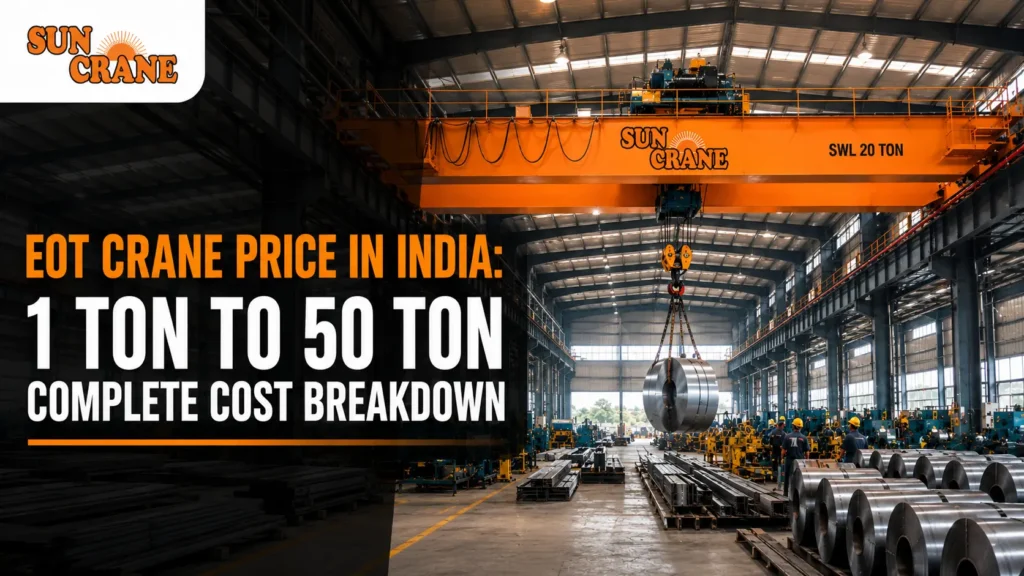
When you’re planning to install an EOT crane in your facility, the biggest challenge isn’t finding a supplier; it’s figuring out whether the price you’re being quoted actually makes sense.
EOT crane pricing in India doesn’t follow a simple formula. Two eot crane manufacturers can quote the same 10 ton capacity crane with a ₹6–8 lakh difference, and both quotes can be technically correct. The difference lies in span, duty class, girder type, and the electrical configuration beneath the surface.
What Is the Price of an EOT Crane in India?
EOT crane price in India starts from around ₹3.5 lakh for a 1 ton single girder unit and can go up to ₹1.5 crore or more for a 50 ton double girder crane. The final price depends on capacity, span, girder type, duty class, and whether installation is included. There is no single fixed price, every crane is configured to site requirements.
EOT Crane Price in India: Quick Reference by Capacity
For buyers who need a fast estimate, here’s a general price range for EOT cranes in India based on capacity and type. These are indicative figures and actual quotes will vary by specification.
| Capacity | Type | Starting From | Typical Range (INR) |
| 1 Ton | Single Girder | ₹3.5 Lakh | ₹3.5 – ₹5.5 Lakh |
| 2 Ton | Single Girder | ₹4.5 Lakh | ₹4.5 – ₹7 Lakh |
| 3 Ton | Single Girder | ₹5 Lakh | ₹5 – ₹8.5 Lakh |
| 5 Ton | Single Girder | ₹7 Lakh | ₹7 – ₹12 Lakh |
| 5 Ton | Double Girder | ₹10 Lakh | ₹10 – ₹15 Lakh |
| 10 Ton | Single Girder | ₹12 Lakh | ₹12 – ₹18 Lakh |
| 10 Ton | Double Girder | ₹16 Lakh | ₹16 – ₹25 Lakh |
| 15 Ton | Double Girder | ₹22 Lakh | ₹22 – ₹35 Lakh |
| 20 Ton | Double Girder | ₹30 Lakh | ₹30 – ₹50 Lakh |
| 30 Ton | Double Girder | ₹50 Lakh | ₹50 – ₹75 Lakh |
| 50 Ton | Double Girder | ₹85 Lakh | ₹85 Lakh – ₹1.4 Crore+ |
Note: These prices are based on a standard 10–12 meter span, Class III duty (M3), pendant control configuration, and are for supply cost only. GST (18%), installation, runway rail, and civil work are not included. The final price may vary based on your actual site requirements.
Single Girder vs Double Girder: Why the Price Difference Matters
One of the biggest pricing factors is whether you need a single girder or double girder EOT crane.
A single girder EOT crane uses one main beam with an underslung hoist. It’s lighter, costs less, and works well for capacities up to 10 tons in standard applications. If your facility has standard headroom and moderate usage, single girder is typically the more practical and economical choice.
A double girder EOT crane uses two main beams with the hoist mounted on top. It supports heavier loads, higher lift heights, and more demanding duty cycles. For capacities of 15 ton and above, or wherever you need high precision, hook height, or continuous operation, double girder is the standard choice.
The price difference between the two configurations can be 40–60% for the same capacity. That gap is justified when your operational needs genuinely call for it, but paying for double girder on a light-duty application is an unnecessary cost.
Key Factors That Affect EOT Crane Price in India
Understanding what goes into the price helps you evaluate quotes more accurately and avoid overpaying for features you don’t need.
1. Crane Span
Span is the horizontal distance between the runway rails. A wider span requires heavier girders and more structural material, which directly increases cost. A 10-meter span crane will cost noticeably less than a 20-meter span crane of the same capacity.
2. Lift Height
Greater hook height means longer hoisting wire rope, taller end trucks, and sometimes a taller hoist unit, all of which add cost.
3. Duty Class
EOT cranes are classified into duty classes (M1 to M8 or IS classifications). A crane built for continuous or heavy-duty industrial use requires better motors, thicker structural components, and more robust electrical systems. If your application is intermittent light use, specifying a higher duty class than required will inflate the cost unnecessarily.
4. Electrical and Controls Configuration
Basic pendant-operated cranes cost less than cranes with radio remote controls, variable frequency drives (VFDs), or programmable logic controllers (PLCs). For precision applications or environments where wired operation is impractical, these upgrades are worth the investment.
5. Material Handling Accessories
A standard hook crane is the base configuration. If you’re lifting coils, billets, containers, or special payloads, you’ll need grab attachments, magnets, spreader beams, or custom fixtures, all of which add to the total cost.
6. Installation and Civil Work
Runway rail installation, gantry column erection, and electrical connection are often quoted separately. Always ask whether your quotation is supply-only or supply-and-install, and factor in civil preparation costs if runway infrastructure doesn’t already exist.
2 Ton EOT Crane Price in India
A 2 ton single girder EOT crane is typically used in small workshops, maintenance bays, and light-duty tool rooms. It’s a budget-friendly entry point for facilities that need overhead lifting without heavy structural investment.
Starting from ₹4.5 lakh, typical range ₹4.5 – ₹7 lakh for standard spans of 6–10 meters. Double girder at this capacity is rarely needed and not commonly specified.
3 Ton EOT Crane Price in India
The 3 ton capacity suits light fabrication units, component assembly areas, and warehouses with moderate material movement. Single girder is the standard choice here. Starting from ₹5 lakh, typical range ₹5 – ₹8.5 lakh depending on span and controls. If your span is under 12 meters and usage is intermittent, a 3 ton single girder will comfortably cover most requirements.
5 Ton EOT Crane Price in India
The 5 ton range is one of the most commonly purchased capacities in small and mid-sized manufacturing units.
A 5 ton single girder EOT crane starts from ₹7 lakh. For a standard span of 10–12 meters with basic pendant controls, most buyers fall in the ₹8–₹10 lakh range.
A 5 ton double girder EOT crane starts around ₹10 lakh and typically goes up to ₹15 lakh for longer spans or special features.
For light fabrication shops, small assembly plants, or warehouses with general material handling needs, the single girder variant usually covers the requirement without unnecessary cost.
10 Ton EOT Crane Price in India
The 10 ton capacity is widely used in medium-scale manufacturing, automotive component plants, steel fabrication units, pump and valve manufacturers, and similar facilities.
A 10 ton single girder crane can be viable up to a span of around 15–16 meters. Starting from ₹12 lakh, typical range ₹12 – ₹18 lakh.
For spans beyond 15 meters or operations requiring higher lift accuracy and heavier-duty cycles, a 10 ton double girder EOT crane is the more appropriate choice, starting from ₹16 lakh with a typical range of ₹16 – ₹25 lakh.
The jump to double girder at 10 ton is a common point where buyers hesitate. The right choice depends on your span requirements and how intensively the crane will operate, not just the load capacity.
20 Ton Double Girder EOT Crane Price
At 20 ton capacity and above, double girder becomes the standard configuration across most applications.
A 20 ton double girder EOT crane in India starts from ₹30 lakh, with a typical range of ₹30 – ₹50 lakh for standard spans in the 12–18 meter range. Longer spans, special electrical packages, or anti-sway systems can push this higher.
This capacity is common in heavy engineering, boiler manufacturing, large casting shops, and shipbuilding-adjacent industries. The pricing at this level reflects not just the structural weight of the crane but also the quality of the hoist unit, gearbox, and drive systems, all of which need to meet higher reliability standards when loads and operating hours are significant.
15 Ton and 30 Ton EOT Crane Price in India
These capacities are common in heavy fabrication, pressure vessel manufacturing, and large machine assembly plants.
A 15 ton double girder EOT crane starts from ₹22 lakh, with a typical range of ₹22 – ₹35 lakh for spans in the 12–18 meter range.A 30 ton double girder EOT crane starts from ₹50 lakh, typically ranging ₹50 – ₹75 lakh. At this capacity, the hoist unit, end carriage design, and motor specifications are all built to a higher standard, which is reflected in the cost.
What Does an EOT Crane Actually Cost in Total?
This is something most buyers underestimate. The crane price you see in a quotation is usually the supply cost only. The actual total cost of installing a working EOT crane includes several additional components:
| Cost Component | Approximate Range |
| Crane supply (ex-works) | Base price as quoted |
| Runway rail and clamps | ₹1.5 – ₹4 lakh depending on span and rail size |
| Civil work (columns, brackets) | ₹2 – ₹8 lakh depending on existing structure |
| Electrical connection and panel | ₹50,000 – ₹2 lakh |
| Erection and commissioning | ₹50,000 – ₹2 lakh |
| GST (18%) | On supply value |
For a 5 ton crane quoted at ₹10 lakh, the total installed cost can realistically be ₹14–₹16 lakh once all of the above is accounted for. Always budget for total installed cost, not just the crane price.
Which EOT Crane Capacity Is Right for Your Industry?
Buyers often ask whether they’re choosing the right capacity. Here’s a practical reference based on common manufacturing applications:
- Light fabrication, tool rooms, small workshops: 1 to 3 ton single girder
- Automotive component plants, pump/valve manufacturers: 5 to 10 ton single or double girder
- Steel fabrication, pressure vessels, boiler shops: 10 to 20 ton double girder
- Heavy engineering, casting shops, large machine assembly: 20 to 50 ton double girder
- Steel mills, port handling, continuous process plants: 50 ton and above, special duty class
If you’re between two capacities, always size up; a crane running consistently close to its rated capacity will wear out faster and cost more in maintenance over time.
A few patterns come up repeatedly when manufacturers are comparing crane quotations.
Comparing base prices without matching specifications
A quote that looks ₹5 lakh cheaper may be using a lighter-duty motor, a shorter warranty, or inferior hoist components. Always compare span, duty class, and hoist specifications side by side.
Ignoring installation costs
Some suppliers quote ex-works and some quote installed. If you’re not accounting for erection, rail installation, and electrical connection, your budgeted number will fall short.
Over-specifying for the application
Buyers in light-duty applications sometimes specify a higher duty class “for safety.” While reasonable caution is valid, over-engineering a crane for light use adds cost without operational benefit. A properly selected M3 or M4 duty class crane will serve a standard fabrication shop reliably for years.
Not accounting for after-sales service proximity
Price is one factor. The supplier’s ability to provide spares and service within a reasonable timeframe matters significantly for long-term cost of ownership.
EOT Crane Price List 2026: What’s Driving Cost Changes
Steel prices, motor costs, and imported electrical component pricing have all seen movement over the past few years. In 2026, buyers should expect prices to reflect current raw material rates rather than older reference figures found on older web pages or catalogues.
When requesting quotes, always ask for validity periods. EOT crane quotations are typically valid for 30–60 days given raw material fluctuations.
Conclusion
EOT crane pricing in India spans a wide range, from under ₹5 lakh for a basic 1 ton single girder unit to ₹1.5 crore or more for a heavy-duty 50 ton double girder crane. The right number for your project depends on capacity, span, duty class, and how the crane will actually be used in your facility.
Before finalising your purchase, get at least two or three detailed technical quotations with matched specifications. Look beyond the headline price and evaluate the total cost of ownership, including installation, warranty coverage, and after-sales support.
Frequently Asked Questions
1. What is the price of a 1 ton EOT crane in India?
A 1 ton single girder EOT crane in India generally costs between ₹3.5 lakh and ₹6 lakh depending on span, lift height, and whether pendant or remote operation is required. It’s the entry-level configuration suitable for small workshops and light assembly applications.
2. What is the EOT crane price per ton in India?
There’s no fixed per-ton rate because structural costs don’t scale linearly with capacity. A 10 ton crane is not simply double the cost of a 5 ton crane. Span, girder type, and duty class affect the final price more significantly than capacity alone.
3. Is single girder cheaper than double girder for the same capacity?
Yes. Single girder EOT cranes are typically 40–60% less expensive than equivalent double girder cranes of the same capacity and span. However, double girder is necessary for higher capacities, longer spans, and demanding duty applications.
4. Does EOT crane price include installation?
Not always. Many suppliers quote supply-only prices. Installation, runway rail supply, civil work, and electrical connection are often quoted separately. Confirm this clearly before finalizing any comparison.
5. What affects EOT crane price the most?
Span is often the biggest variable for a given capacity. A 10 ton crane with a 25-meter span will cost considerably more than a 10 ton crane with a 12-meter span. After span, duty class and electrical configuration have the most impact.
6. How long does it take to manufacture and deliver an EOT crane in India?
Standard configurations typically have a lead time of 4–8 weeks from order confirmation, depending on capacity and supplier workload. Custom configurations or imported components may extend this to 10–12 weeks.