
Choosing the right industrial hoist comes down to one core decision: wire rope hoist or chain hoist. Both are used for vertical lifting on EOT cranes and jib cranes, and both are available in manual and electric versions – but the lifting mechanism inside them is completely different, and that difference decides everything else: capacity, speed, price, and where each type fits best on a factory floor.
This guide covers every major hoist type used in Indian factories and yards, how lifting capacity is determined, and what current market pricing looks like across different tonnage ranges – so you can match the right hoist to your application before you buy, not after.
What Is an Industrial Hoist?
An industrial hoist is the lifting unit itself – the motor, drum or pocket wheel, and brake assembly that raises and lowers a load. It usually sits on something else that handles the sideways movement: an EOT crane bridge, a jib crane arm, or a fixed monorail beam. Simple way to remember it – the hoist does the up-and-down, the structure underneath does the side-to-side.
Two things define any hoist: what it lifts with, and what powers it. The lifting medium is either steel wire rope wound around a grooved drum, or a load chain drawn through a pocket wheel. The power source is manual (hand-operated) or electric (motor-driven), with pneumatic and hydraulic covering the more specialised cases. Get either of these wrong for your application and you’ll feel it – in cycle time, in maintenance cost, usually within the first year of running the thing.
Manual and Electric: The Power Source Decision Comes First
Before you even weigh chain against wire rope, figure out whether the job needs a manual hoist or an electric one. This trips up more first-time buyers than you’d expect, mostly because it’s easy to assume “chain hoist” automatically means manual and “wire rope hoist” means electric. It doesn’t work that way. Both lifting mediums come in manual and electric form – the power source is a completely separate call.
Manual hoists are hand-operated, either by pulling a hand chain through a pocket wheel or working a ratchet lever. No power connection needed, which is exactly why they turn up in maintenance bays, remote sites, and anywhere a steady electrical supply isn’t a given. Running one is slower and more physically demanding than an electric unit, sure, but there’s very little inside a manual chain pulley block that can actually go wrong. That simplicity is basically the whole selling point.
Electric hoists use a motor to do the lifting, and this is what you’ll find on most production floors doing any real volume of lifts. An electric chain hoist or electric wire rope hoist can cycle dozens of times a shift without wearing the operator out, and it holds a far more consistent lift speed than a hand-operated unit ever could. The catch is upfront cost, plus a proper power supply and periodic electrical maintenance – motor windings, brakes, limit switches, all of it needs checking on a schedule.
Most Indian manufacturing units end up with a mixed setup: electric hoists carrying the daily production load, and a manual chain pulley block kept around for occasional lifts, maintenance jobs, or backup when the power goes out. The two aren’t really competing for the same job. They solve different problems, and a well-run facility tends to keep both around.
Types of Industrial Hoists
Manual Chain Pulley Block
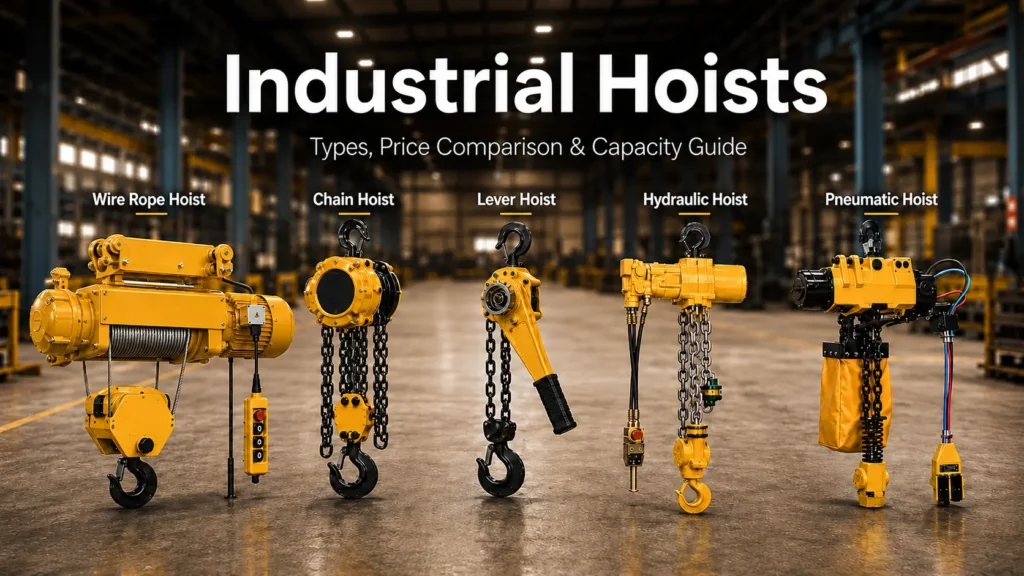
This is really the entry point of the whole hoist category – a hand-chain operated block, no motor, no wiring, just a mechanical ratio built into the gear train that lets one person move loads far beyond what they could lift on their own. Indian manufacturers build these to IS 3832, and capacities typically run 0.5 to 20 tons, sometimes more for the heavy-duty specials. Because there’s nothing to power or programme, a chain pulley block is usually the cheapest hoist on any procurement list – and often the first thing a small workshop buys, well before it invests in anything electric.
Lever Hoist (Ratchet Hoist)
Think of it as a close cousin to the chain pulley block, except it’s built for pulling as well as straight vertical lift – handy for tensioning cables, aligning machinery, or rigging at an angle where you don’t have a fixed overhead point. Compact, fully manual, and honestly you’ll find one in a rigger’s toolkit far more often than bolted onto a crane. Field-maintenance work is really where it earns its keep.
Electric Chain Hoist
Motorise that same chain-and-pocket-wheel setup and you land on the electric chain hoist – compact, reasonably quiet, and the default pick for light-to-medium duty lifting up to around 5 tons. Built in India to IS 6547, and it’s what most people actually have in mind when they search for a general-purpose factory hoist. There are two configurations here: a fixed, hook-suspended unit for a stationary lifting point, or a trolley-mounted version that travels along a beam. The trolley type costs more, but it’s what you need for anything beyond one fixed spot – don’t pay for a trolley you don’t need, and don’t try to skip one you do.
Electric Wire Rope Hoist
This one’s the workhorse for heavier, higher-frequency lifting. Wire rope hoists in India fall under IS 3938, with standard capacities running from around 500 kg up through 50 tons, and a handful of manufacturers pushing that as far as 90 tons for steel plant and port work. Instead of a chain, steel wire rope winds onto a machined drum – the same tensile strength that lets it handle heavier loads is also what lets it lift faster over greater heights. Steel fabrication, EOT crane installations, anywhere cycle speed matters as much as capacity – that’s wire rope hoist territory.
Pneumatic (Air) Hoist
Swap the electric motor for compressed air and you get a hoist that carries no spark risk – the obvious pick for paint shops, chemical plants, and oil and gas facilities where an electric motor is a genuine ignition hazard. Yes, they cost more to run because of the compressed air overhead. But in an explosive or flammable atmosphere, that’s not really a cost decision anymore.
Hydraulic Hoist / Jack Hoist
Used less for everyday material handling and more for high-force, short-travel jobs – machinery alignment, structural jacking during erection, anywhere you need a huge amount of lifting force over a limited stroke rather than height. It’s a specialist’s tool, not really a shop-floor staple.
For nearly every factory though, the real decision comes down to just two of these six: an electric chain hoist or an electric wire rope hoist. That’s the comparison genuinely worth spending time on, so here’s the full breakdown.
Wire Rope Hoist vs Chain Hoist: How They Actually Differ
A wire rope hoist lifts using steel cable wound around a grooved drum. A chain hoist lifts using a load chain drawn through a pocket wheel. That single mechanical difference is basically the root cause of everything else that separates them – capacity, speed, headroom, cost, where each one earns its keep on a factory floor.
Wire rope hoists dominate at the heavy end. Past roughly 5 tons, or wherever a fast lift over a tall height matters, wire rope is usually the only practical option – a chain of comparable strength would end up bulky and slow by comparison. Chain hoists hold their ground at lighter capacities, where precision matters more than raw speed: assembly lines, machine shops, any workstation where a load needs to stop and hold exactly where you put it.
| Parameter | Wire Rope Hoist | Chain Hoist |
| Lifting Medium | Steel wire rope on a grooved drum | Load chain through a pocket wheel |
| Typical Capacity | 0.5 ton to 50+ tons | 0.25 ton to 5 tons (electric); up to 20 tons (manual) |
| Lifting Speed | Faster – suited to high-cycle, high-volume lifting | Slower – better suited to precise, controlled positioning |
| Headroom Required | More (drum and rope guide need space) | Less – compact enough for low-headroom sheds |
| Indoor/Outdoor Use | Both, with periodic rope inspection | Both, more tolerant of rugged conditions |
| Applied IS Standard | IS 3938 | IS 6547 (electric) / IS 3832 (manual) |
| Maintenance | Higher – rope inspection, drum grooving checks | Lower – simpler mechanism, fewer wear points |
| Relative Cost | Higher, especially at high capacity and lift height | Lower, generally 30-50% less at comparable capacity |
| Best Fit | Steel plants, ports, foundries, heavy fabrication | Workshops, assembly lines, warehouses, maintenance bays |
One detail buyers often miss: a wire rope hoist introduces a small amount of sway during lift, simply because the rope sits in a grooved drum rather than driving straight through a pocket wheel. For most industrial lifting, honestly, this doesn’t matter. But if your process needs true, sway-free vertical lift – fine assembly work, say – a chain hoist is actually the more precise machine here, not the cheaper compromise.
How Do You Choose the Right Hoist Capacity?
Undersizing a hoist is a safety failure waiting to happen. Oversizing it wastes capital, and on a wire rope hoist, adds headroom and structural load your building may not even need to carry. Work through it in this order:
- Calculate the actual load weight, including the heaviest single item you’ll lift plus any attachments – slings, spreader beams, magnets, or grabs. All of that counts toward rated capacity.
- Add a safety margin. Most Indian manufacturers recommend a hoist rated at least 10-15% above your maximum expected load – not your average load.
- Check duty class, not just tonnage. A hoist rated for 5 tons at Class M3 (light, intermittent duty) is a genuinely different machine from one rated for 5 tons at Class M6 (heavy, near-continuous duty), even if the tonnage on the nameplate looks identical. Running a light-duty hoist at high cycle rates is one of the most common causes of premature motor and brake failure – honestly, this is the mistake that shortens a hoist’s life more than anything else.
- Factor in lift height and speed. Taller lifts on a wire rope hoist need a bigger drum to store the extra rope length, which changes the physical footprint and headroom of the unit.
- Match the hoist to the supporting structure – an EOT crane bridge, jib crane arm, or monorail beam rated for the combined dead weight and dynamic load.
As a rough reference, electric chain hoists in India commonly cover 250 kg up to 5,000 kg, while electric wire rope hoists start around 500 kg and scale into the tens of tons for steel and port work.
What Does an Industrial Hoist Actually Cost in India?
Pricing depends on brand, duty class, lift height, and control type – pendant versus radio remote – but here’s what current market listings actually show, broken down roughly the way most buyers search for it.
At the broadest level, here’s how the spread across categories looks:
| Hoist Type | Capacity Range | Approx. Price Range (INR) |
| Manual chain pulley block | 0.5 – 5 ton | ₹5,000 – ₹40,000 |
| Electric chain hoist | 0.25 – 5 ton | ₹25,000 – ₹1,50,000 |
| Electric wire rope hoist | 0.5 – 5 ton | ₹80,000 – ₹4,00,000 |
| Electric wire rope hoist (heavy duty) | 10 – 20 ton | ₹4,00,000 – ₹9,00,000+ |
| Complete hoist with double girder trolley | 15 ton+ | ₹5,00,000 – ₹14,00,000+ |
Indian Standards That Apply to Hoists
Compliance isn’t optional in industrial procurement, and it’s usually one of the first things a safety auditor checks. The relevant Bureau of Indian Standards (BIS) specifications are:
- IS 3832 – Hand-Operated Chain Pulley Blocks
- IS 6547 – Electric Chain Hoists
- IS 3938 – Electric Wire Rope Hoists
- IS 807 / IS 3177 – Design, erection, and testing of the cranes hoists are mounted on, including EOT and gantry cranes
Any hoist supplier operating in India should be able to point to compliance with the relevant standard for whatever product type you’re buying. Beyond BIS certification, hoists also carry a duty class (M1 to M8) – a scheme aligned with FEM and ISO classifications internationally – which rates how much cyclic loading the mechanism is built to handle over its service life. Two hoists can carry the same tonnage rating on paper and still be very different machines once you actually look at duty class.
Installation, Maintenance, and What Actually Breaks Down
Chain hoists are, by design, low-maintenance. The chain-and-pocket-wheel mechanism just has fewer failure points than a rope-and-drum system, which is a big part of why chain hoists dominate maintenance bays and machine shops where uptime matters more than raw lifting speed.
Wire rope hoists demand more attention. The rope itself needs periodic inspection for broken strands, kinking, and corrosion – a worn rope is a genuine safety hazard, not just a cosmetic issue. Drum grooving, rope guide alignment, and brake wear also need regular checks, especially on hoists running multiple shifts. This is the part most buyers underestimate at purchase time: a wire rope hoist’s total cost of ownership includes rope replacement cycles that a chain hoist simply never has.
Both types require load testing at 125% of rated capacity before commissioning, and periodic re-certification after that, consistent with the testing regime under IS 3177 for the cranes they’re usually mounted on.
Matching the Hoist to the Application
- Under 5 tons, indoor, frequent cycling: Electric chain hoist. Lower upfront cost, lower maintenance, and precise enough for assembly and general fabrication work.
- Above 5 tons, or where fast cycle times matter: Electric wire rope hoist. Built for the load and the speed a chain mechanism simply can’t match at that capacity.
- Explosive or flammable environment, any capacity: Pneumatic hoist first, regardless of tonnage.
- Outdoor, exposed to weather, heavy-duty steel or port work: Wire rope hoist, typically mounted on a Goliath or semi-goliath crane rather than an EOT.
- Tight budget, low headroom, non-continuous use: Chain hoist, manual or electric depending on how often you’re lifting.
If your operation genuinely sits in the overlap zone – say, 3-6 tons with moderate cycling – the deciding factor usually isn’t capacity at all. It’s headroom and maintenance capacity. A shop with a dedicated maintenance team can absorb a wire rope hoist’s upkeep without too much trouble; one without that support is usually better off sticking with a chain hoist, even if it means slightly slower cycle times.
Final Thoughts
There’s no universally “better” hoist between a wire rope hoist and a chain hoist – only the one that actually matches your load, duty cycle, and environment. Get the capacity and duty class right, buy from a manufacturer that can show BIS compliance under IS 3938 or IS 6547, and factor maintenance cost into the decision alongside the sticker price. That’s really what separates a hoist that runs for fifteen years from one that’s back in the workshop within eighteen months.
FAQs
1. What is the difference between a wire rope hoist and a chain hoist?
A wire rope hoist lifts using steel cable wound around a drum, while a chain hoist lifts using a load chain drawn through a pocket wheel. Wire rope hoists handle heavier loads and faster lifting speeds, typically from 1 ton upward, while chain hoists suit lighter loads under 5 tons where precision and compact size matter more than speed.
2. Do chain hoists and wire rope hoists come in manual versions too?
Yes. Both lifting mediums are available as manual or electric units – a manual chain pulley block and a motorised electric chain hoist are two different products within the same chain hoist category. Manual wire rope hoists exist as well, though they’re far less common than electric ones since wire rope is usually chosen specifically for heavier, higher-speed lifting.
3. How much does an electric wire rope hoist cost in India?
Electric wire rope hoist price scales closely with tonnage: a 1 ton unit typically runs ₹55,000-₹95,000, a 3 ton unit ₹95,000-₹1,50,000, and a 5 ton wire rope hoist ₹1,50,000-₹2,50,000, all for a basic hook-suspended configuration without a trolley.
4. What Indian standard applies to hoists?
Electric wire rope hoists follow IS 3938, electric chain hoists follow IS 6547, and manual chain pulley blocks follow IS 3832. The EOT or gantry cranes these hoists mount on are covered separately under IS 807 and IS 3177.
5. How do I decide which hoist to buy for my factory?
Start with your actual maximum load, add a 10-15% safety margin, and check the required duty class based on how often the hoist will cycle – not just the tonnage. For loads under 5 tons with frequent, precise lifting, a chain hoist usually fits best. For heavier loads or high-speed cycling, a wire rope hoist is the better long-term choice despite the higher upfront cost.