
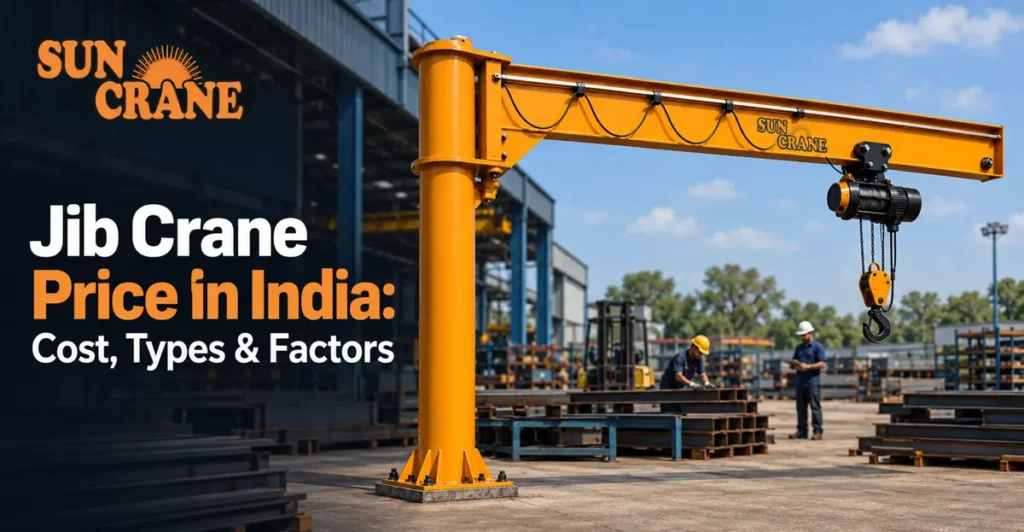
Jib crane price in India typically ranges from about ₹60,000 for a small 500 kg unit to ₹8 lakh or more for a heavy-duty 5 ton motorized crane. The exact price depends on load capacity, boom length, lifting height, rotation angle, hoist type and installation – so a specification-based quotation is essential.
If you are searching for the jib crane price in India, the honest answer is that there is no single “market rate.” A jib crane is built around your application, so two cranes of the same tonnage can be priced very differently depending on their reach, height, rotation, hoist and how they are mounted. This guide gives you realistic indicative ranges and, more importantly, explains exactly which inputs decide the final quotation – so you can budget accurately and ask for the right configuration.
Jib Crane Price in India: Quick Overview
As a rough guide, small standard jib cranes start from around ₹60,000-₹1,00,000, mid-range factory cranes fall between ₹1.5 lakh and ₹4.5 lakh, and heavy-duty or fully motorized custom cranes run to ₹8 lakh and beyond. Online marketplace listings show a very wide spread for exactly this reason: the price follows the specification, not the label. Treat any single figure as a starting point and always confirm the technical scope before comparing quotes.
Jib Crane Price by Load Capacity
Capacity is the first thing that moves the price. Heavier loads need a stronger column, boom and foundation, and usually a larger hoist. Indicative ranges by capacity:
| Capacity | Typical Use | Indicative Price Range* |
| 500 kg | Small workshop, maintenance bay | ₹60,000 – ₹1.2 lakh |
| 1 ton | Machine loading, workstations | ₹90,000 – ₹1.8 lakh |
| 2 ton | Factory bays, loading stations | ₹1.5 – ₹3 lakh |
| 3 ton | Assembly & fabrication areas | ₹2.5 – ₹4.5 lakh |
| 5 ton | Heavy material handling | ₹4 – ₹8 lakh + |
*Indicative only. Final price depends on type, span, lifting height, hoist and installation. A 1 ton jib crane price, for example, changes significantly between a short wall-mounted arm and a long motorized pillar-mounted unit.
Jib Crane Price by Type
After capacity, the mounting type has the biggest impact on cost. Each type suits a different situation:
| Type | Capacity | Best For | Cost Driver |
| Portable / mobile | 500 kg-1 ton | Small shops, shifting work | Base design & hoist |
| Wall-mounted | 500 kg-2 ton | Machine loading, workstations | Building structural support |
| Pillar / floor-mounted | 1-5 ton | Factory bays, assembly | Foundation, boom, slew angle |
| Motorized (electric slew) | 1-5 ton + | Repetitive high-duty handling | Motor, hoist & controls |
Pillar-mounted jib crane price is higher than a wall-mounted unit of the same capacity because it is self-supporting: it needs its own column and a reinforced foundation, but in return it can offer up to 360° rotation. A wall-mounted jib crane saves floor space and costs less, but it depends on a suitable building column or wall to carry the load and is usually limited to around 180°-200° of swing.
Portable and mobile jib cranes are the most affordable option for small workshops and maintenance work where the crane must be moved between locations, though their capacity and reach are limited.
Electric vs Manual Jib Crane: Price Difference
A manual jib crane – with manual rotation and a chain block – is the lowest-cost configuration and works well for occasional, light lifting. An electric jib crane, with motorized slewing and an electric wire-rope hoist or chain hoist, costs more but is far faster and less tiring for frequent, repetitive handling. For a busy production line the higher price is usually recovered quickly in labour and cycle time.
Factors That Affect Jib Crane Price
When you request a quotation, these are the inputs that move the number up or down:
● Load capacity (safe working load)
● Boom / arm length and working radius
● Lifting height and column height
● Rotation / slew angle (180°, 270° or 360°)
● Duty class and lifting frequency
● Hoist type and brand (chain vs wire rope, manual vs electric)
● Electrical panel, pendant control and VFD for smooth slewing
● Anti-collision and safety accessories
● Surface preparation, painting and finish
● Foundation design, transport and installation
Jib Crane Price by Boom Length and Height
A longer boom does more than add material – it increases the bending load on the column, which means a heavier column, a larger foundation and often a bigger counterbalance. The same is true for lifting height. So a modest increase in reach or height can raise the price more than buyers expect, which is why the arm length and height must be stated clearly in any enquiry.
What Is Included in a Jib Crane Quotation?
A clear quotation should list these items separately so you can compare suppliers fairly:
● Crane structure (column and boom)
● Hoist and trolley
● Pendant / remote control and electricals
● Foundation bolts and design details
● Installation, testing and commissioning
● Transport / freight
● GST
Additional costs to budget for: civil foundation work, on-site erection, electrical cabling to the crane, annual maintenance and any statutory load-testing. Asking for these up front prevents surprises after the order.
How to Choose the Right Jib Crane for Your Factory
Use this quick checklist before you ask for a quote:
● Maximum load weight you will lift
● Working radius (how far the load must travel)
● Lifting height and available headroom
● Lifting frequency (occasional vs continuous)
● Floor/building structure and space available
● The material path and any obstructions
Getting these six inputs right is what turns a rough budget figure into an accurate, like-for-like quotation.
Jib Crane vs EOT Crane: Which Is More Cost-Effective?
For lifting within a single workstation or a fixed radius, a jib crane is the more cost-effective choice – lower price, smaller footprint and simple installation. When you need to cover a whole bay or move loads across the full width and length of a shop, an EOT (electric overhead travelling) crane is the better investment despite the higher cost. Many factories use both: EOT cranes for bay-wide handling and jib cranes at individual machines and loading points.
Why Buy a Custom Jib Crane From a Manufacturer?
Buying direct from a manufacturer means the crane is designed around your exact load, reach and duty – with the right hoist selected, the foundation loads calculated correctly, and proper after-sales support and spares. An application-specific crane is safer, lasts longer and often works out cheaper over its life than an off-the-shelf unit that is a poor fit for the job.
Frequently Asked Questions About Jib Crane Price
1. How long does it take to manufacture and deliver a jib crane in India?
A standard jib crane is usually built and delivered within a few weeks, while fully custom or heavy-duty motorized cranes take longer. Lead time depends on capacity, customization and current order load, and is confirmed at the time of order.
2. What warranty do jib cranes usually come with?
Most manufacturers provide a warranty on the crane structure and mechanical parts, with the hoist and electrical components covered as per their own brand warranty. Always confirm the warranty period and what it covers before ordering.
3. Is load-test certification mandatory for a jib crane in India?
Lifting equipment in industrial use is generally subject to periodic load testing and certification under local factory and safety regulations. A reputable supplier will load-test and certify the crane at commissioning and advise you on the periodic testing you need to maintain.
4. What is the typical service life of a jib crane?
A well-built jib crane that is correctly sized for its duty and maintained regularly can last many years of reliable service. Overloading, skipping maintenance or under-sizing the crane for a heavy duty cycle are the main things that shorten its life.