
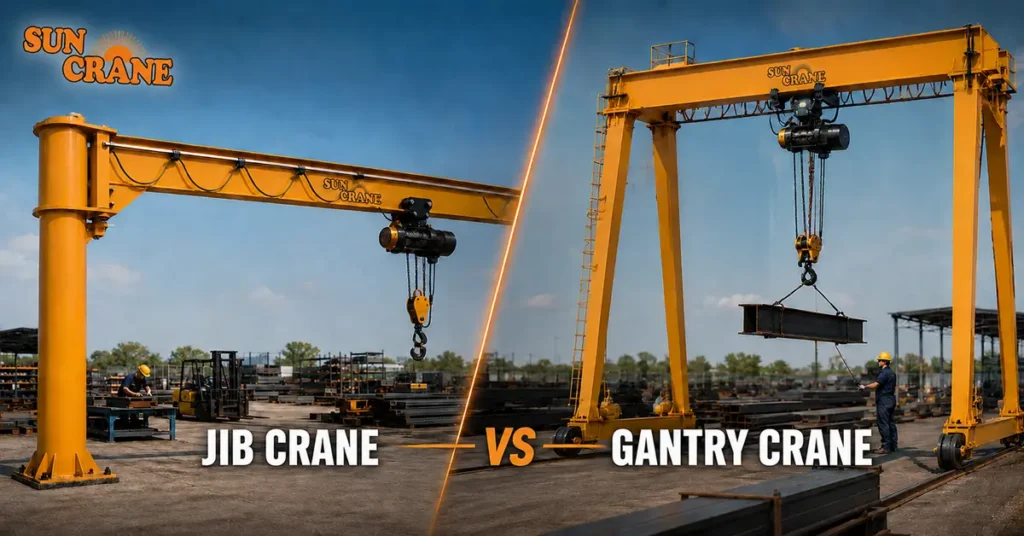
A jib crane offers circular/arc coverage around a fixed pillar or wall mount, suits light-to-medium loads (about 250 kg to 10 ton), and needs minimal civil work. A gantry crane spans a rectangular area on rails or wheels, handles medium-to-heavy loads (1 ton to 50+ ton) over wide spans, and needs more floor space and civil work. Jib = workstation lifting; gantry = yard and bay coverage.
Choosing between a jib crane and a gantry crane is one of the most common decisions in workshop and material-handling planning. Both lift and move loads – but they do it in very different ways, at very different costs, and for very different applications.
A jib crane provides compact, rotational lifting around a fixed point, ideal for a single workstation. A gantry crane spans a wide area and travels across it, making it suited to yards, warehouses and heavy outdoor work. Picking the wrong one means either paying for coverage you do not need, or buying a crane that cannot reach where you work.
This guide compares jib cranes and gantry cranes in full – their types, coverage, capacity, cost, installation and best applications – so you can confidently choose the right crane for your space, budget and lifting needs.
Jib Crane vs Gantry Crane – Key Differences at a Glance
| Parameter | Jib Crane | Gantry Crane |
| Structure | Pillar or wall-mounted arm | Portal frame on rails or wheels |
| Coverage | Circular / arc (around a point) | Rectangular (across a bay) |
| Working range | ~2 m to 12 m radius | Up to ~30 m span |
| Load capacity | ~250 kg to 10 ton | 1 ton to 50+ ton |
| Movement | Rotational (slewing) | Linear (travels along bay) |
| Footprint | Compact | Requires floor / ground space |
| Civil work | Minimal | Rail foundation, ground prep |
| Best for | Workstation lifting | Yards, warehouses, heavy work |
Structure & Design
A jib crane consists of a horizontal arm (the jib) mounted to a vertical pillar or a wall. The arm rotates, and a hoist runs along it. A gantry crane uses a portal frame – a bridge beam supported by two legs – that travels along the ground on rails or wheels, with a hoist running across the bridge.
Coverage Area & Working Radius
A jib crane covers a circular or arc-shaped area defined by its arm length and rotation. A gantry crane covers a rectangular area defined by its span and travel length. This is the single biggest practical difference: jib cranes serve a point, gantry cranes serve a zone.
Load Capacity Range
Jib cranes typically handle 250 kg up to around 10 ton, suited to light and medium-duty tasks. Gantry cranes range from 1 ton to 50 ton and beyond, built for medium to heavy-duty lifting.
Mobility & Movement Type
Jib cranes provide rotational (slewing) movement around a fixed base – some smaller versions are portable. Gantry cranes provide linear movement, travelling along a bay on rails or wheels, and portable versions can be moved where needed.
Space Requirements & Footprint
A jib crane has a compact footprint and does not consume floor space across a bay. A gantry crane needs clear ground space for its legs and travel path, and for rail-mounted versions, a prepared rail foundation.
Cost Breakdown: Jib Crane vs Gantry Crane Price in India
Note: The figures below are indicative ranges only. Actual prices depend on capacity, span, arm length, type, duty class, hoist selection and installation scope. Always request a specification-based quotation for an accurate figure.
Jib Crane Price Range (Wall, Pillar, Floor-mounted)
Jib cranes are the more economical option, especially for lighter capacities. As an indicative guide, jib cranes in India broadly range from around ₹35,000 for small, light-duty units to ₹4.5 lakh or more for higher-capacity, larger-reach pillar-mounted models.
Gantry Crane Price Range (Fixed, Portable, Semi-gantry)
Gantry cranes generally carry a higher initial cost because of their larger structure, wider coverage and heavier capacities. Portable workshop gantries sit at the lower end, while large rail-mounted full gantry cranes for heavy outdoor use sit significantly higher.
Installation & Civil Work Cost Comparison
This is where the total cost gap often widens. A jib crane needs minimal civil work – a foundation for a pillar mount, or fixing to an existing wall. A gantry crane, particularly rail-mounted, needs a rail foundation, ground preparation and alignment, which adds meaningfully to the project cost.
Maintenance & Operational Cost Over 5 Years
Jib cranes, being simpler, generally have lower maintenance demands. Gantry cranes have more components – travel wheels, rails, longer structures – and so typically involve more maintenance over their life. Factor lifetime cost, not just purchase price, into your decision.
| Cost Factor | Jib Crane | Gantry Crane |
| Initial equipment cost | Lower | Higher |
| Civil / foundation cost | Minimal | Higher (rails, ground prep) |
| Installation time | 1–2 days | 1–2 weeks |
| Maintenance over time | Lower | Higher |
Types of Jib Cranes & Gantry Cranes
Jib Crane Types
Wall-mounted jib crane: Fixed to a wall, saving floor space; ideal where a pillar cannot be installed.
Pillar-mounted (free-standing) jib crane: Mounted on its own floor-fixed pillar; offers wide rotation and flexible placement.
Floor-to-ceiling jib crane: Supported at both floor and roof structure for greater stability and reach.
Portable jib crane: A movable, often lighter-duty jib that can be relocated between work areas.
Gantry Crane Types
Fixed gantry crane: A permanent, rail-mounted gantry for a defined working zone.
Portable / workshop gantry crane: A wheel-mounted, lighter gantry that can be moved around a workshop.
Semi-gantry crane: One leg runs on a ground rail and the other on an elevated runway, useful where floor space is partly constrained.
Full gantry crane (rail-mounted): A large, heavy-duty gantry running on ground rails, used for wide spans and heavy outdoor lifting.
Which Crane Is Best for Your Application?
Jib Crane Applications
• CNC machine loading and service
• Welding stations
• Loading docks
• Maintenance pits and repair bays
• Individual workstations needing repetitive, localised lifting
Gantry Crane Applications
• Precast concrete yards
• Shipyards
• Rail yards
• Outdoor storage areas
• Transformer and heavy equipment assembly
Typical Scenario: A Workshop Setup
For a workshop where lifting happens repeatedly at one or two machines, a jib crane is usually the better fit – compact, economical and quick to install, with rotational reach exactly where it is needed.
Typical Scenario: A Precast or Yard Operation
For a precast manufacturing unit or an outdoor yard where loads must move across a wide area, a gantry crane is usually the right choice – its span and travel cover the full working zone that a jib crane simply cannot reach.
Installation Requirements & Timeline
Jib Crane Installation
Installation is relatively simple: prepare a foundation for a pillar mount (or fix to a suitable wall), erect the pillar and arm, fit the hoist and commission. This can often be completed in 1–2 days with minimal disruption.
Gantry Crane Installation
Installation is more involved: lay and align the rails (for rail-mounted types), prepare the foundation, assemble the portal structure, fit the hoist and travel mechanism, then align and commission. This typically takes 1–2 weeks depending on size and site conditions.
Retrofit Feasibility in Existing Buildings
A jib crane is generally easier to retrofit into an existing building, needing only a mounting point and foundation. A gantry crane needs rail infrastructure and ground preparation, making retrofits more demanding.
Capacity & Duty Class Selection Guide
Jib Crane Capacity Options
Jib cranes commonly range from 250 kg to about 10 ton, in the light-to-medium duty range – well matched to workstation and repetitive lifting tasks.
Gantry Crane Capacity Options
Gantry cranes range from 1 ton to 50 ton and beyond, in the medium-to-heavy duty range – suited to continuous, high-load operations.
Duty Class Considerations
Beyond capacity, match the duty class (under FEM / IS standard classifications) to how often and how hard the crane will work. Intermittent workstation use needs a lighter class; continuous heavy handling needs a higher one. Choosing on tonnage alone, without duty class, is a common and costly mistake.
Hoist & Trolley Selection
Both crane types carry a hoist and trolley sized to the load. Wire rope hoists suit higher capacities and lift heights; chain hoists suit lighter loads. The hoist must be matched to the crane’s rated capacity and your lifting height.
Jib Crane vs Gantry Crane vs EOT Crane
It helps to see all three overhead options side by side, since buyers often weigh them together:
| Factor | Jib Crane | Gantry Crane | EOT Crane |
| Coverage | Arc around a point | Rectangular bay (ground) | Full bay (overhead) |
| Capacity | 250 kg–10 ton | 1–50+ ton | Light to very heavy |
| Civil / structure | Minimal | Rails / ground prep | Building runway needed |
| Best use | Workstation lifting | Yards, outdoor, precast | In-building bay lifting |
In short: a jib crane serves a spot, a gantry crane serves a ground-level zone (often outdoors), and an EOT crane serves an entire building bay from overhead runway beams.
Buying Guide: How to Choose Between a Jib and Gantry Crane
Work through these five steps to arrive at the right choice:
Step 1: Assess your lifting requirements: Determine your maximum load, lift height and how frequently you will lift.
Step 2: Evaluate available space and layout: Is lifting concentrated at one point (jib) or spread across an area (gantry)?
Step 3: Consider building structure and civil constraints: Can you install a pillar or wall mount, or do you have room for rails and a gantry?
Step 4: Analyse the budget: Compare initial cost plus civil work, installation and lifetime maintenance – not just the equipment price.
Step 5: Plan for future expansion: Choose a crane that can handle reasonable growth in load or coverage rather than one you will outgrow quickly.
Final Word
The jib crane vs gantry crane decision comes down to coverage and cost. If your lifting happens at a fixed point – a machine, a welding bay, a loading dock – a jib crane gives you compact, economical, rotational reach with minimal installation. If your loads must move across a wide area, a yard or an outdoor space, a gantry crane gives you the span, capacity and travel that a jib cannot.
Assess your load, your space, your civil constraints and your total lifetime cost. Match the crane to how and where you actually lift, and you will get safe, efficient handling and real long-term value – whichever type you choose.
Frequently Asked Questions (FAQ)
1. Which is cheaper: a jib crane or a gantry crane?
A jib crane is generally cheaper, both in initial cost and installation, especially for lighter capacities. A gantry crane costs more because of its larger structure, wider coverage, higher capacities and the rail or ground work it often requires. For like-for-like light-duty lifting at a single point, the jib crane is usually the more economical choice.
2. Can I install a jib crane without civil work?
A wall-mounted jib crane can often be installed with little to no floor civil work if a suitable structural wall is available. A pillar-mounted jib crane needs a foundation for its base, but this is still far less civil work than a rail-mounted gantry crane requires.
3. What is the typical installation time for each crane type?
A jib crane can usually be installed and commissioned in about 1–2 days. A gantry crane, especially a rail-mounted one, typically takes around 1–2 weeks because of rail laying, foundation work, structural assembly and alignment.
4. Which crane is better for outdoor applications?
A gantry crane is generally better for outdoor applications such as precast yards, storage areas and shipyards, because it travels across open ground on rails or wheels and covers wide spans. Jib cranes are better suited to fixed indoor workstations.
5. Can I upgrade from a jib crane to a gantry crane later?
You cannot directly convert a jib crane into a gantry crane, as they are different structures. However, you can add a gantry crane later as your needs grow. If you anticipate needing wider coverage soon, factor that into your initial decision and space planning.