When it comes to selecting an EOT crane for your facility, one question comes up almost every time: should you go with a single girder or a double girder?
It sounds straightforward. But the wrong choice can cost you money, slow down operations, or create safety issues down the line. That’s why consulting an experienced EOT crane manufacturer is essential before making a decision.
This guide breaks down the real difference between single girder and double girder EOT cranes, how they’re built, how they perform, and which one suits your specific lifting requirements.
What Is a Single Girder EOT Crane?
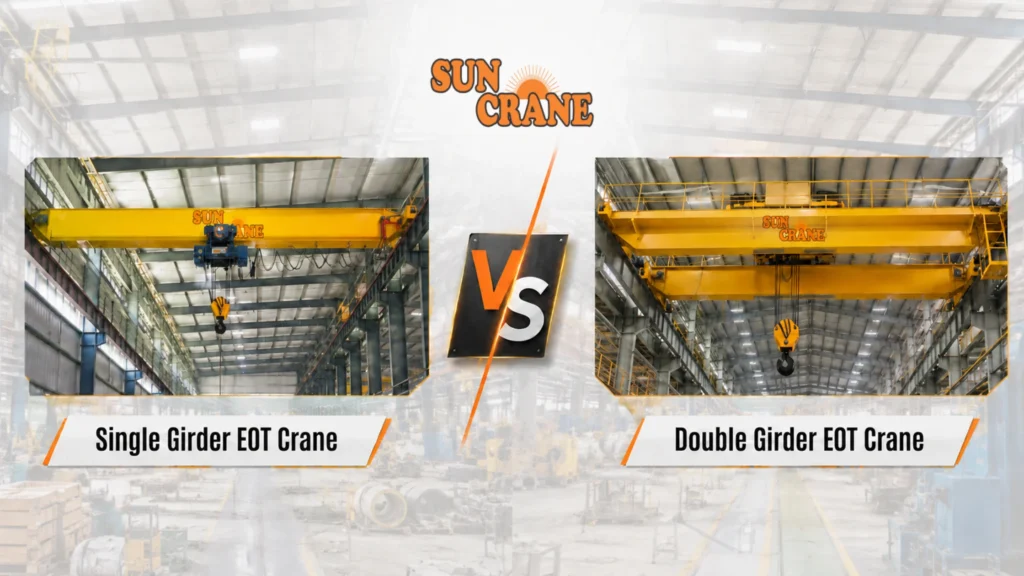
A single girder EOT crane uses one main bridge beam (girder) that runs across the span of the runway rails. The hoist and trolley travel along the bottom flange of this single beam.
This design keeps the structure lighter and more compact. It works well for workshops, small production units, and facilities that don’t need very high lifting capacities.
Typical specifications for single girder EOT cranes:
- Lifting capacity: Up to 15–20 tonnes (varies by manufacturer and span)
- Span: Generally up to 20 metres
- Lifting height: Moderate, limited by the underslung hoist position
- Duty class: Light to medium duty (Class I to III)
Because the hoist hangs below the girder, the hook height is slightly reduced compared to a double girder setup. This matters when your building has height limitations.
What Is a Double Girder EOT Crane?
A double girder EOT crane has two parallel bridge beams. The hoist trolley runs on top of the two girders, which allows the hook to reach a greater height.
This configuration is built for heavy-duty industrial use, steel plants, heavy fabrication units, large warehouses, and other environments where loads are heavy and operations run frequently.
Typical specifications for double girder EOT cranes:
- Lifting capacity: From 5 tonnes to over 200 tonnes (custom-built for heavy requirements)
- Span: Can extend well beyond 30 metres
- Lifting height: Higher hook height due to top-running trolley
- Duty class: Medium to heavy duty (Class III to VI)
The two-girder structure also provides better stability during lifts, especially when loads are heavy or the span is long.
Single Girder vs Double Girder EOT Crane: Key Differences
Here’s a clear comparison to help you evaluate both crane types:
| Parameter | Single Girder EOT Crane | Double Girder EOT Crane |
| Structure | One main bridge beam | Two parallel bridge beams |
| Lifting Capacity | Up to 15–20 tonnes | 5 tonnes to 200+ tonnes |
| Hook Height | Lower (hoist below girder) | Higher (hoist on top of girders) |
| Span | Shorter spans (up to ~20 m) | Longer spans (20 m to 35 m+) |
| Duty Class | Light to medium | Medium to heavy |
| Cost | More economical | Higher initial cost |
| Building Load | Less structural load on building | Requires stronger building structure |
| Maintenance Access | Limited | Better (walkway on girders) |
| Installation | Simpler and faster | More complex |
| Ideal For | Light workshops, assembly lines | Heavy manufacturing, steel plants, shipyards |
Difference Between Single Girder and Double Girder Crane: A Deeper Look
Beyond the table, there are practical differences that affect your day-to-day operations.
1. Hook Height and Headroom
Single girder cranes mount the hoist below the beam. This costs you some usable lift height. If your facility has a low ceiling, this limits how high you can lift a load.
Double girder cranes mount the trolley on top of the girders. This gives you more clearance from the floor to the hook, which is critical in tall buildings or when you need to lift materials over tall equipment or structures.
2. Trolley Mechanism: Electric Hoist vs. Crab Trolley
This is a difference many buyers overlook, and it matters technically.
In a single girder crane, a standard electric wire rope hoist is used. It clamps directly onto the bottom flange of the girder and travels along it. The mechanism is simple, compact, and works well for light to medium loads.
In a double girder crane, a crab-type trolley is used instead. This is a dedicated motorised unit that sits on top of the two girders and runs on rails mounted across them. The crab trolley is built for heavier loads, offers better control during lifts, and allows the hook to travel between the girders, giving you more usable hook height.
This distinction also affects spare parts, maintenance complexity, and hoist replacement cost over the crane’s lifetime.
3. Load Capacity and Span
Single girder designs work well for moderate loads. As the span gets longer, the beam deflects more under load, this puts structural stress on the beam and limits how much weight it can safely carry.
Double girder designs distribute the load across two beams. This reduces deflection, improves stability, and allows the crane to handle much heavier loads over longer spans without compromising safety.
3. Operational Frequency
If your crane runs only a few cycles per shift, a single girder unit handles the job well. But if you’re running heavy lifts continuously throughout the day, like in a steel fabrication plant or an automotive line, a double girder crane is better suited to handle that workload consistently without stress on the structure.
4. Maintenance and Inspection
On a double girder crane, the space between the two girders provides a working platform. Maintenance engineers can walk on it to inspect the hoist, motors, and electrical systems directly. This makes regular inspection safer and more practical.
Single girder cranes don’t have this walkway, so maintenance work requires additional access equipment.
5. Cost Difference
Single girder cranes cost less to manufacture, install, and commission. If your capacity and span requirements fall within its range, it’s a practical and economical choice.
Double girder cranes involve more material, stronger runway structures, and a more complex installation. But if your operations demand it, the performance justifies the investment.
Which EOT Crane Is Best for Heavy-Duty Use?
For heavy-duty lifting, loads above 15–20 tonnes, long spans, high-duty cycle operations, a double girder EOT crane is the right choice.
Industries that typically need double girder cranes:
- Steel and metal fabrication plants: handling heavy plates, coils, and structural members
- Heavy manufacturing units: moving machinery, large components, and assemblies
- Power plants: lifting turbines, generators, and large maintenance equipment
- Mining and processing facilities: handling bulk loads and heavy equipment
- Railways and shipyards: assembling, repairing, and moving large components
For lighter operations, single girder cranes are the preferred option in:
- Workshops and small production units
- Warehouses with moderate load requirements
- Assembly lines with light to medium components
- OEM facilities where cost-efficiency matters
EOT Crane Selection Guide for Indian Industries
Choosing between single girder and double girder EOT cranes in India depends on several factors. Here’s what to evaluate before you finalize your purchase:
1. Required Lifting Capacity
Start here. If your maximum load is under 10–12 tonnes, a single girder works well. If you’re lifting 15 tonnes or more regularly, move to a double girder.
2. Span of the Bay
Measure the distance between your runway rails. For spans beyond 20 metres, double girder designs offer better structural performance and load stability.
3. Available Hook Height
Check how much clear height you have in your building. If you need maximum hook height to lift materials above existing equipment, a double girder gives you more usable height.
4. Duty Cycle as per IS Standards
Indian EOT cranes are classified under IS:3177 from Class I (light, infrequent use) to Class VI (continuous heavy-duty operation). Always specify your IS duty class before selecting a crane type. Single girder cranes typically cover Class I to III; double girder cranes handle Class III to VI. Getting this wrong means the crane wears out faster than expected.
5. Building Structure
Single girder cranes are lighter and put less load on your runway beams and building columns. Double girder cranes are heavier; your civil structure must be designed or verified to support the additional load.
6. Long-Term Maintenance
If your facility can’t afford unplanned downtime, double girder cranes offer better access for inspection and maintenance, reducing the risk of extended outages.
Note for Indian buyers: Industries in manufacturing hubs like Pune, Ahmedabad, Rajkot, Coimbatore, and Ludhiana have specific operational patterns, high production volume, frequent crane cycles, and cost sensitivity. In these environments, selecting the right IS duty class upfront saves significant repair and replacement costs over 10–15 years.
A Quick Note on EOT Crane Types Comparison
Both single girder and double girder cranes fall under the broader category of Electric Overhead Travelling (EOT) cranes. The “EOT” in the name simply means the crane travels electrically along overhead runways.
Within EOT cranes, you also have variants like underslung cranes, top-running cranes, and semi-gantry configurations. The single girder vs double girder choice is specifically about the bridge structure, and it’s one of the most important decisions you’ll make when specifying a crane.
Need Help Choosing the Right EOT Crane?
Not sure whether a single girder or double girder crane fits your facility? Sun Crane’s team will evaluate your span, capacity, and duty requirements and recommend the right configuration for you. Get in touch for a free consultation.
Frequently Asked Questions
1. What is the maximum capacity of a single girder EOT crane?
Single girder EOT cranes typically handle up to 15–20 tonnes. Beyond that range, a double girder design is more appropriate for safe and stable operation.
2. What is the lifting capacity of a double girder EOT crane?
Double girder EOT cranes can handle loads from 5 tonnes to over 200 tonnes depending on the design, span, and duty requirements. They are built for heavy-duty and high-frequency operations.
3. What is the main difference between single girder and double girder crane?
The primary difference is the bridge structure. A single girder uses one beam; a double girder uses two. This affects the crane’s capacity, hook height, span capability, and suitability for different duty cycles.
4. Which EOT crane is better for heavy-duty industrial use?
Double girder EOT cranes are better suited for heavy-duty operations. Their dual-beam structure provides higher load capacity, greater hook height, longer span support, and better overall stability for demanding applications.
5. How do I choose between single and double girder EOT crane?
Base your decision on your required lifting capacity, bay span, hook height needed, and operational frequency. If you’re unsure, consult a crane manufacturer like Sun Crane who can evaluate your facility and recommend the right configuration.