
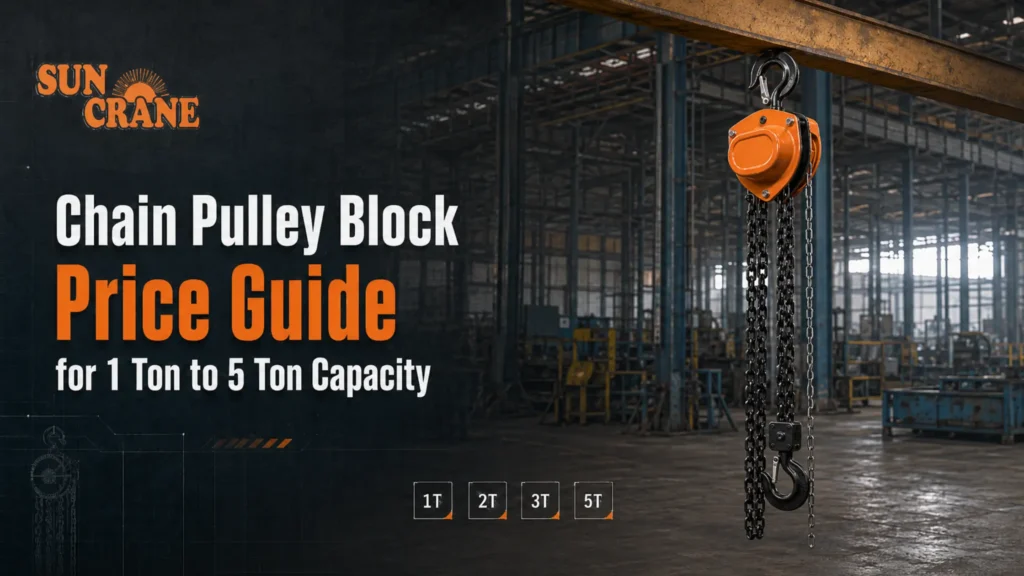
Most people sourcing a chain pulley block ask the same thing first: What’s the price going to be? Fair question. But the honest answer is: it depends. The chain pulley block price isn’t a single number. It shifts based on how much you need to lift, how high, what kind of duty your application demands, and the quality of the unit itself. A 1-ton block for a small workshop is a very different product from a 5-ton block being used in a heavy fabrication plant.
This guide covers realistic pricing for 1 ton, 2 ton, 3 ton, and 5 ton capacities and the factors that actually move the price up or down. One thing worth knowing before you read further: all pricing here is based on the standard 3-meter lift height, which is the most common configuration across the Indian market.
What Is a Chain Pulley Block?
A chain pulley block, also known as a hand chain hoist or chain block hoist, is a manual device used to lift or lower heavy loads. Pull the hand chain; it drives a gear mechanism, and the load chain raises the hook. Simple in principle, but the build quality and specifications matter a lot in practice.
You’ll find them in use across the following:
- Manufacturing plants and assembly lines
- Warehouses and storage facilities
- Construction and erection work
- Maintenance and repair bays
- Steel plants and fabrication shops
They work well where there’s no power supply nearby or where setting up an overhead crane doesn’t make sense for a smaller or occasional lift.
Chain Pulley Block Price by Capacity: A General Reference
Not all chain pulley blocks are priced the same, even within the same capacity. Brand, chain grade, and safety certification can push the price into very different territory. The table below splits each capacity into three segments so you can see what you’re actually comparing. All figures are for 3-meter standard lift height models in the Indian market.
| Capacity | Budget / Economy | Industrial Grade | Premium / Certified | Realistic Average Range |
| 1 Ton | ₹2,600 – ₹4,800 | ₹7,500 – ₹13,000 | ₹18,000 – ₹27,500 | ₹5,000 – ₹10,500 |
| 2 Ton | ₹3,000 – ₹5,500 | ₹9,500 – ₹14,500 | ₹28,000 – ₹36,000 | ₹6,000 – ₹14,000 |
| 3 Ton | ₹5,800 – ₹8,500 | ₹12,000 – ₹20,000 | ₹38,000 – ₹50,000 | ₹8,000 – ₹20,000 |
| 5 Ton | ₹8,000 – ₹12,500 | ₹13,000 – ₹22,000 | ₹55,000 – ₹70,000 | ₹12,000 – ₹25,000 |
These are approximate figures for 3-meter standard lift height models. Final pricing depends on brand, chain quality, safety certification, and application type. Get in touch with Sun Crane for an accurate quote on your requirement.
Breaking Down the Price by Capacity
1 Ton Chain Pulley Block Price
The 1-ton chain block is probably the most common size you’ll come across in workshops, maintenance bays, and general lifting. At a standard 3-meter lift height, you can find economy models starting as low as ₹2,600 to ₹4,800. But for regular industrial use, those rarely hold up well. Most buyers end up in the ₹7,500 to ₹13,000 range, which gets you a proper industrial-grade unit with better chain quality and a usable duty rating.
IS-certified or premium-brand units go higher, ₹18,000 to ₹27,500, and there are valid reasons to spend that if safety compliance or high-frequency use is a requirement. For general planning, the ₹5,000 to ₹10,500 band is where most realistic 1-ton purchases land.
It handles light industrial work well, positioning machine parts, lifting components during a service job, that kind of thing.
2 Ton Chain Pulley Block Price
The 2-ton is a heavily used capacity for automotive workshops, fabrication units, and midsize manufacturing plants. Loads are heavier but still lifted manually without needing a crane. The chain pulley block 2 ton price ranges quite widely, and it matters which end of the market you’re buying from.
Economy units sit at ₹3,000 to ₹5,500. They’re cheap, but they’re really built for occasional or light use, not day-in, day-out industrial work. The industrial-grade range of ₹9,500 to ₹14,500 is what most serious buyers in this segment should be looking at. Certified or premium units go from ₹28,000 to ₹36,000. For most standard industrial procurement, plan around ₹6,000 to ₹14,000.
One thing that often surprises buyers: going from 1 ton to 2 tons isn’t a small step. The gear ratio changes, the load chain gets noticeably heavier, and the frame needs more structural strength. All of that shows up in the price and in the unit’s longevity under regular use.
3 Ton Chain Pulley Block Price
Three-ton units sit in the mid-heavy range. Steel processing units, heavy warehouse applications, and erection sites, are where the 3-ton earns its keep. It’s a capacity that genuinely needs a proper industrial-grade build.
Budget models start at ₹5,800 to ₹8,500, but if your facility is using this block regularly, that range probably won’t last you long. The ₹12,000 to ₹20,000 industrial-grade segment is where most buyers end up, and for good reason. Certified or premium units run from ₹38,000 to ₹50,000, which is justified when strict compliance or demanding duty cycles are involved. The ₹8,000 to ₹20,000 range covers the majority of real procurement decisions in this category.
Looking To Choose The Right Chain Pulley Block For Your Industry?
Sun Crane helps industrial buyers select reliable chain pulley blocks based on lifting capacity, application requirements, and operational needs.
4 Ton Chain Pulley Block Price
4-ton chain pulley blocks are available, but that capacity sees comparatively low demand in India, and most buyers aren’t actively sourcing it. If you’re a purchase manager, plant engineer, or facility head narrowing down options, this should help you walk in better prepared.
5 Ton Chain Pulley Block Price
At 5 tons, you’re in heavy territory, and the 5-ton chain pulley block price reflects that. This is the capacity for heavy die lifts, large structural work, and shifting industrial equipment that simply can’t be moved any other way manually.
The price gap between the cheapest and most expensive units at this capacity is significant. Economy units start at ₹8,000 to ₹12,500, but most plant buyers won’t touch these for serious heavy-duty work. The industrial-grade segment runs from ₹13,000 to ₹22,000, and that’s the realistic buying zone for most facilities. Premium or IS-certified units, where safety ratings and chain quality are held to tighter standards, range from ₹55,000 to ₹70,000. For day-to-day industrial procurement, plan around ₹12,000 to ₹25,000.
The reason the range is so wide? Everything about the unit is heavier, thicker load chains, stronger hooks with safety latches, and beefier suspension frames. The premium-end units aren’t just more expensive for the name; the engineering difference is real.
Key Factors That Influence Chain Pulley Block Pricing
Two purchases can look identical on a quote, have the same capacity, and have the same lift height and be completely different in value. Here’s what actually separates them.
1. Lifting Capacity
More capacity costs more. That part is obvious. What’s less obvious is that oversizing also adds dead weight to the unit, which matters if operators are carrying the block between lifts.
2. Lift Height
Standard models ship with 3-meter chains. Need 5 or 6 meters? That extra chain adds weight and material cost. Always confirm your actual working height before ordering.
3. Load Chain Material
Grade 80 alloy steel chains are lighter and stronger than standard carbon steel. They cost more upfront, but they last noticeably longer under daily industrial use. Worth it if the block is being used regularly.
4. Duty Class
A chain block rated for light duty is built very differently from one rated for heavy duty. If your application involves multiple lifts every day, a light-duty unit will wear out fast. Match the duty class to how the block will actually be used, not just to the maximum load.
5. Body Construction
Cast iron bodies are cheaper but add weight. Steel-forged or aluminum alloy bodies cost more but give you better strength without the bulk. If operators need to carry the block frequently, the lighter body pays for itself in ease of use.
6. Brand and After-Sales Support
A block from a manufacturer who stocks spare parts and stands behind their product is worth more than the price difference suggests. When a load chain or hook needs replacing in the middle of a production schedule, the supplier who can turn it around quickly saves you far more than you’d save buying cheap upfront.
What to Check Before Buying a Chain Pulley Block
Price gets you in the door. These are the checks that keep you out of trouble after the purchase:
- IS or BIS certification: Confirms the unit is built to Indian safety standards for lifting equipment.
- WLL (Working Load Limit) marking: Should be clearly stamped or labeled on the unit, not just on the box.
- Hook throat opening: Make sure it fits the beam or lifting point in your facility before ordering.
- Brake mechanism: The ratchet brake should hold the load firmly when you stop pulling. Test it during commissioning, not after something goes wrong.
- Chain condition: Check for smooth movement, no kinks, and proper lubrication, especially on units that have been stored.
- Spare parts lead time: Can the supplier get you a replacement load chain or hook within a reasonable time? Find this out before you need it.
Mistakes to Avoid When Purchasing
Going purely on price. A cheap unit that fails mid-lift doesn’t just cost money; it creates safety risks. The replacement and downtime costs usually end up far more than the savings.
Ignoring the duty class. If your operation runs multiple lifts a day, a light-duty block simply isn’t built for that. It’ll wear out faster than expected and need replacing sooner.
Not measuring lift height. It sounds basic, but running short on chain at the jobsite is a frustrating and avoidable problem. Measure your actual working height before you place the order.
Assuming spares are always available. Some suppliers price low but don’t carry replacement parts. When something needs fixing, you end up waiting. Ask about spare parts availability upfront.
Conclusion
Chain pulley block pricing isn’t hard to understand once you know what you’re actually comparing. The same 3-ton label can mean a ₹6,000 economy unit or a ₹45,000 certified one, and the difference matters depending on how and where it’s being used.
Get the capacity right. Confirm the lift height. Match the duty class to your actual usage. Those three things will tell you more about the right price than any catalogue ever will.
Frequently Asked Questions
1. What is the standard lift height for chain pulley blocks?
Most standard models come with a 3-meter chain. If you need more, 5 meters, 6 meters, or beyond, that’s available on request, but it adds to the price.
2. Can a chain pulley block be used for horizontal pulling?
No. Chain blocks are designed for vertical lifting only. If you need to pull horizontally, a lever hoist (also called a ratchet hoist) is the right tool for that job.
3. What’s the difference between a chain pulley block and an electric chain hoist?
A chain block is manual, needs no power, and has lower maintenance. An electric hoist is faster and less physically demanding, but it needs a power source and requires more upkeep. The right choice depends on your frequency of use and site conditions.
4. How often does a chain block need to be inspected?
A quick functional check before each use is good practice. A proper formal inspection by a qualified person should happen at least once a year, more often if the unit is under heavy daily use.
5. Do suppliers offer better pricing on bulk orders?
Usually, yes. For larger procurement, equipping multiple bays, stocking a project site, or multi-location requirements, volume pricing is available. Sun Crane handles bulk requirements regularly, so it’s worth discussing your numbers directly.