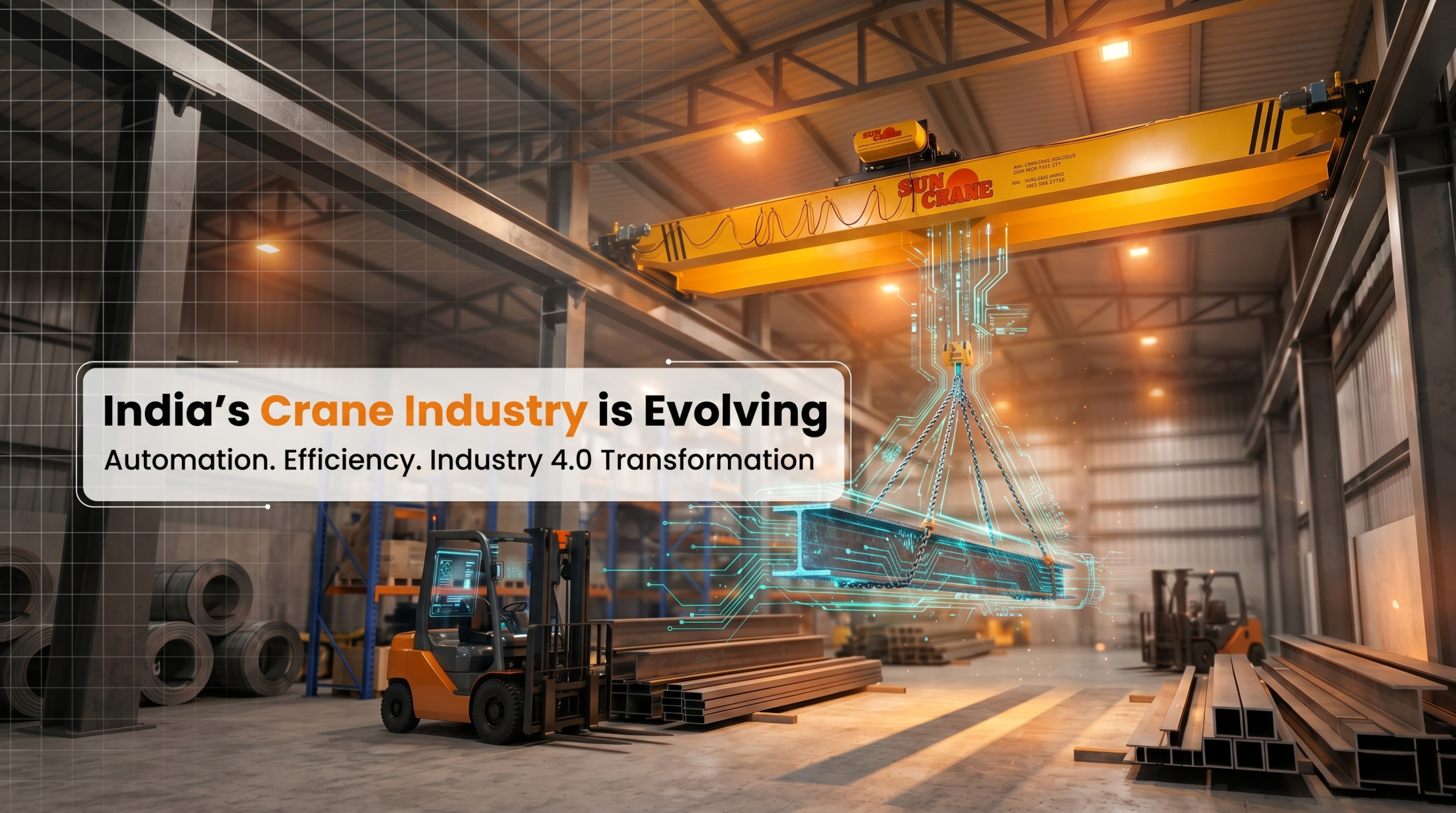
India’s industrial engine is running harder than ever. With manufacturing output expanding rapidly under national initiatives and infrastructure investment reaching record levels, the demand for heavy lifting – quite literally – has never been greater.
According to EOT crane market analysis, India’s crane market is projected to grow at 10.8% CAGR, driven by steel, logistics, and large-scale construction. Yet growth alone doesn’t tell the full story.
Traditional cranes, designed for straightforward load-and-lift operations, are increasingly ill-suited to the precision demands of Industry 4.0 facilities. Manual operation, limited diagnostics, and high energy consumption are becoming genuine bottlenecks. The shift towards smart overhead cranes India manufacturers are now prioritising reflects a deeper transformation – from reactive, operator-dependent lifting to data-driven, automated systems that integrate with broader factory intelligence.
This modernisation isn’t simply about upgrading equipment. It’s about rethinking what a crane does within a connected facility. And to understand why that matters, it helps to first examine why the EOT crane itself remains so foundational to Indian industry.
Why EOT Cranes Remain the Backbone of Industrial Lifting
India’s manufacturing surge hasn’t simply created demand for more lifting equipment – it’s reinforced why the Electric Overhead Travelling (EOT) crane specifically remains irreplaceable across the industrial landscape.
Versatility is the defining advantage. EOT cranes operate effectively in steel mills, automotive assembly plants, and large logistics warehouses – environments with vastly different load requirements and floor layouts. Few alternative lifting solutions match that range.
Reliability reinforces the case further. EOT designs offer a fixed, overhead load path that mobile or jib alternatives simply cannot replicate at scale. Downtime in a steel melt shop or an automotive press line carries enormous cost consequences.
Critically, emerging technology is augmenting EOT architecture, not dismantling it. The core bridge-and-hoist structure remains unchanged; what’s evolving sits on top – variable frequency drives, load monitoring systems, and energy recovery mechanisms. As the JSW Steel Integrated Report 2024-25 illustrates, heavy industry continues to depend on overhead lifting infrastructure as operational volumes climb.
The EOT crane isn’t a legacy technology awaiting replacement – it’s a proven platform being actively upgraded for the next industrial era.
Understanding how those upgrades are landing in practice means examining the future trends in overhead crane automation reshaping operations right now – which is precisely where things get interesting.
The Smart Revolution: Automation and Telematics
Understanding why EOT cranes dominate is one thing – understanding where they’re heading is quite another. The most significant shift occurring across the Indian industry right now isn’t simply about lifting capacity. It’s about intelligence.
From Reactive to Proactive: Sensor-Driven Insights
Modern EOT cranes are increasingly equipped with embedded sensors that monitor structural stress, motor temperature, and load distribution in real time. Rather than waiting for a component to fail – an event that can halt an entire production line – these systems flag anomalies before they escalate. The cost of unplanned downtime typically far exceeds the cost of preventive intervention, making early warning systems one of the most commercially compelling features in today’s crane specifications. This shift towards data-driven operations is precisely what distinguishes forward-thinking facilities from those still running on reactive maintenance schedules.
Remote Operation: Safer, Smarter Lifting
Traditional overhead crane operation placed workers in elevated cabins – a configuration that carries inherent risk. Remote-operated EOT systems now allow operators to manage lifts from a ground-level control station, with full visibility via camera feeds and real-time telemetry. The result is measurably improved site safety alongside greater operational precision.
WMS Integration for Warehouse Environments
In logistics and warehousing, automation goes a step further. Leading custom smart EOT crane manufacturers India are engineering cranes that communicate directly with Warehouse Management Systems (WMS), enabling automated pick-and-place cycles, inventory-linked lift sequencing, and throughput data that feeds back into broader operational analytics.
What powers all of this capability reliably over a crane’s working life, however, comes down to one critical discipline: predictive maintenance.
Predictive Maintenance: The End of Unplanned Downtime
The automation and telematics capabilities discussed earlier don’t just improve operational control – they fundamentally transform how maintenance is managed. In facilities relying on energy efficient EOT cranes manufacturing workflows, unplanned downtime isn’t merely inconvenient; it can halt entire production lines.
Modern EOT cranes now deploy real-time sensor arrays that continuously monitor:
- Motor temperature and thermal stress
- Vibration signatures indicating bearing wear
- Load cycle counts tracking structural fatigue
What typically happens is that anomalies surface weeks before a failure occurs, giving engineers a genuine window to intervene. This dramatically reduces Mean Time to Repair (MTTR) – shifting maintenance from reactive scrambles to scheduled, planned interventions.
Predictive maintenance doesn’t just prevent breakdowns; it quietly extends the entire structural lifecycle of a crane by years. With fewer emergency repairs and reduced mechanical shock events, the crane’s framework, hoists, and drive systems experience significantly less cumulative stress.
The business case is compelling. However, the benefits extend beyond cost – as operational efficiency improves, so does the opportunity to examine how these intelligent systems consume energy. That leads naturally to one of 2026’s most pressing questions for Indian industry: can smarter cranes also become greener ones?
Efficiency by Design: The Rise of Energy-Efficient EOT Cranes
With smarter diagnostics already reshaping maintenance strategies, India’s industrial operators are applying that same forward-thinking logic to energy consumption. The result is a new generation of EOT cranes engineered not just to lift, but to consume as little power as possible whilst doing so.
Regenerative Braking: Gravity as a Power Source
One of the most compelling advances in modern crane design is regenerative braking – a system that captures kinetic energy during load deceleration and converts it back into usable electricity. Rather than dissipating that energy as heat (as conventional braking does), regenerative systems feed it back into the facility’s power grid. In energy-intensive environments like steel plants or port terminals, this can meaningfully reduce overall electricity consumption across an entire shift.
Variable Frequency Drives: Smoother, Leaner Operation
Variable Frequency Drives (VFDs) are equally transformative. By adjusting motor speed precisely to match load requirements, VFDs eliminate the energy spikes associated with traditional fixed-speed motors. Movement becomes smoother, mechanical wear reduces, and power draw drops significantly. The cost-benefit case for retrofitting existing cranes with VFDs alone is compelling – lower energy bills and reduced component replacement costs typically deliver a strong return within a few years.
Reducing Industrial Carbon Footprint
Heavy industry accounts for a substantial share of India’s energy demand, and Tata Consulting Engineers’ recent analysis highlights the growing pressure on manufacturers to demonstrate measurable sustainability improvements. Energy-efficient crane systems directly support these goals – cutting both operational costs and carbon emissions simultaneously.
These efficiency gains aren’t isolated achievements. They’re converging with a broader wave of innovation that’s set to redefine what EOT cranes are capable of in 2026 and beyond.
Top 5 Overhead Crane Trends to Watch in 2026
Energy efficiency and predictive diagnostics have set the foundation – but the innovation pipeline for EOT cranes extends well beyond those gains. Here are the five trends reshaping procurement decisions across India’s industrial sector right now.
1. AI-Driven Anti-Sway Technology Load oscillation remains one of the leading causes of workplace incidents and cycle-time losses. AI-powered anti-sway systems continuously calculate and counteract pendulum motion in real time, dramatically improving both safety and throughput.
2. Modular Crane Designs Facilities increasingly need flexibility. Modular configurations allow rapid reconfiguration as production layouts evolve – reducing costly downtime during facility changes.
3. Hybrid Power Systems For operations in remote locations or areas with unstable grid supply, hybrid power (combining diesel generation with battery storage) ensures uninterrupted lifting capacity without overreliance on external infrastructure.
4. Augmented Reality Operator Assistance AR-enabled interfaces overlay load data, clearance warnings, and operational guidance directly into an operator’s field of vision, reducing human error significantly.
5. Cybersecurity for Networked Systems As cranes become increasingly connected, securing those networks against unauthorised access is no longer optional – it’s a procurement requirement.
Each of these trends carries genuine cost implications, making the investment case worth examining carefully.
The Cost-Benefit Reality: Is the Investment Worth It?
The honest answer is yes – but context matters. Smart EOT cranes carry higher capital expenditure (CAPEX), yet consistently deliver lower operational expenditure (OPEX) through reduced energy consumption, fewer unplanned breakdowns, and extended service intervals.
Smart crane technology delivers its strongest returns where operational continuity is non-negotiable.
For procurement leads, the long-term value of partnering with specialist custom smart EOT crane manufacturers in India lies in tailored engineering solutions designed for your specific load cycles, facility layout, and production targets, rather than off-the-shelf compromises.
Key takeaways before you decide:
- Weigh total lifecycle cost, not just the purchase price
- Prioritise manufacturers offering IoT integration and after-sales support
- Demand transparency on projected energy savings and maintenance schedules
India’s industrial momentum, reflected in sustained infrastructure investment per DPIIT’s annual reporting, signals that smarter material handling isn’t a luxury – it’s a competitive baseline. The pivot to intelligent, energy-efficient EOT cranes in 2026 is less a question of whether and more a question of when.